

Revenue Assumption Baseline
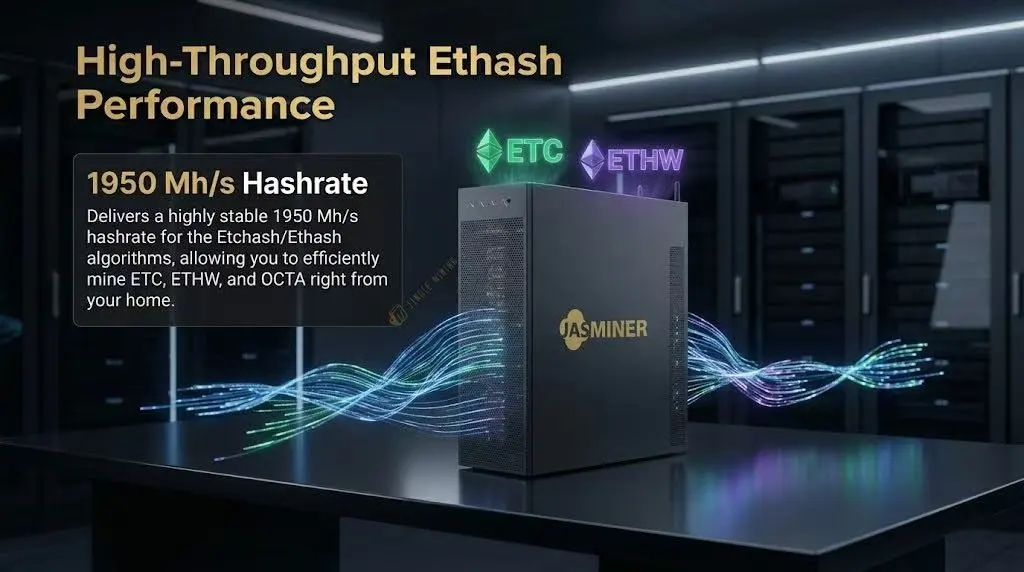
The JASMINER X16-Q, with its specified 1950 Mh/s hashrate targeting the EtHash/Etchash algorithm, presents a baseline for potential revenue generation within the Ethereum Classic ecosystem. This hashrate, when applied to current network conditions and the prevailing price of ETC, forms the initial calculation for daily gross revenue. However, the efficiency of 0.32 W/MH is a critical factor, directly influencing the operational expenditure side of the profitability equation. A lower W/MH figure signifies better energy efficiency, meaning more hashing power is generated per unit of electricity consumed, which is paramount in a cost-sensitive mining environment.
The interplay between hashrate, network difficulty, and coin price is dynamic. While the X16-Q offers a consistent hashrate, the difficulty of mining ETC can fluctuate significantly, impacting the amount of ETC an operator can expect to earn daily. Furthermore, the market price of ETC itself is subject to considerable volatility. Therefore, any revenue projection must account for these variables, understanding that the stated hashrate is the ceiling for potential earnings, but actual realized revenue will be a product of this hashrate multiplied by the network's current mining difficulty and the prevailing market value of ETC, minus the energy costs dictated by its 620W power draw and the local electricity rate.
Strategic ROI Matrix
To accurately assess the financial viability of deploying the JASMINER X16-Q, a focused examination of key financial variables is essential. This matrix outlines the core inputs and their direct impact on the return on investment and the time required to recoup the initial capital expenditure.
The JASMINER X16-Q's efficiency of 0.32 W/MH is a strong suit, suggesting that for every megahash of mining power, it consumes a relatively low amount of electricity. This efficiency directly combats the negative impact of rising operational expenditures, a critical component in determining the payback period. While the 1950 Mh/s hashrate provides a solid foundation for revenue, the 620W power draw means that electricity costs will be a substantial factor in the overall profitability. The efficiency metric is therefore key to mitigating the financial pressure exerted by the power consumption.
Macro-to-Micro Payback Pressure
Recent shifts in the broader cryptocurrency market, including fluctuations in Bitcoin's price and increased institutional interest in digital assets, can exert indirect pressure on smaller altcoin markets like Ethereum Classic. While the JASMINER X16-Q is purpose-built for EtHash, a significant downturn in the overall crypto sentiment can lead to reduced demand and price depreciation for ETC. This translates directly into a lower potential daily revenue, thereby extending the payback period for the miner. Conversely, positive macro trends that boost overall crypto market confidence can lift ETC's price, enhancing the X16-Q's revenue-generating capacity and accelerating ROI.
Furthermore, the global energy market's volatility, influenced by geopolitical events and supply chain issues, directly impacts electricity rates, a primary OPEX component for any mining operation. An increase in electricity prices, even with a constant hashrate and efficiency, will directly inflate operational costs, diminishing profit margins and pushing the payback timeline further out. Miners utilizing the JASMINER X16-Q must therefore monitor not only network-specific metrics but also broader energy market trends to accurately forecast their investment recovery and overall profitability.
Payback Verdict & Next Steps
The JASMINER X16-Q, with its commendable efficiency rating of 0.32 W/MH and a respectable 1950 Mh/s hashrate for EtHash mining, presents a compelling case for operators prioritizing energy-conscious Ethereum Classic extraction. However, the ultimate payback period is intricately tied to the volatile nature of ETC's market price and the ever-present pressure of network difficulty adjustments, alongside the significant operational cost dictated by its 620W power draw. A thorough, personalized financial model is imperative to navigate these variables. Contact JingleMining today for a custom ROI analysis, procurement validation, and expert deployment consulting to ensure your investment strategy is aligned with current market realities.
Frequently Asked Questions (FAQ)
Q: What variables matter most in payback analysis?
A: The most critical variables in payback analysis include the miner's hashrate, power consumption, operational efficiency, the current network difficulty of the targeted cryptocurrency, and the cryptocurrency's market price. Electricity costs are also a paramount factor, directly influencing operational expenditures.
Q: How does electricity cost change the ROI outlook?
A: Electricity cost is a direct operational expense that reduces the net profit generated by mining. Higher electricity costs will inevitably lead to a longer payback period and a lower overall return on investment, as more of the generated revenue is consumed by energy expenditure.
Q: What should buyers verify before trusting a payback estimate?
A: Buyers should verify the source and accuracy of the hashrate and power consumption figures, cross-reference the estimated electricity rate with their actual local costs, and research current and historical network difficulty trends for the targeted coin. It is also wise to understand the price volatility of the cryptocurrency being mined.