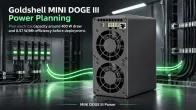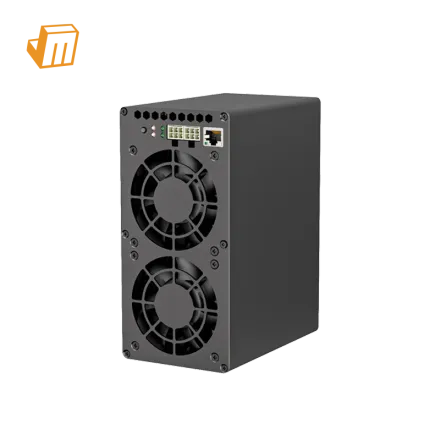

The Goldshell MINI DOGE III serves as a purpose-built entry into Scrypt-based cryptocurrency mining, delivering a consistent 700.00 Mh/s hashrate at a 400 W power consumption. Its primary commercial advantage is its compact form factor and optimized efficiency of 0.57 W/Mh, which positions it as a viable solution for hobbyist environments where noise and thermal output must be strictly controlled. However, this efficiency rating, while respectable for a desktop-class unit, limits its competitive viability in industrial-scale operations that rely on high-density ASIC infrastructure to minimize overhead. Prospective buyers must evaluate this unit against the reality of fluctuating network difficulty and localized electricity tariffs, as the fixed 400 W power draw dictates a rigid operating cost structure that cannot be scaled or throttled as effectively as larger, enterprise-grade mining hardware.
Performance Metrics and Operational Classification
The Goldshell MINI DOGE III operates within a specific performance bracket defined by its 700.00 Mh/s output on the Scrypt algorithm. This output is calibrated for consistent production of LTC and DOGE, focusing on stability rather than the aggressive overclocking found in large-scale mining farms. With an efficiency rating of 0.57 W/Mh, the device occupies a middle ground in the current hardware ecosystem. It provides enough throughput to participate meaningfully in smaller pool distributions, but it does not compete with the total hash-density of larger, rack-mounted ASICs designed for multi-megawatt facilities.
The core consequence of this 400 W power draw is a predictable thermal and electrical baseline. Because the efficiency is fixed at 0.57 W/Mh, any deviation in electricity costs directly impacts the net profitability of the unit. For the hobbyist, this means the hardware remains operational as long as the revenue generated from the 700.00 Mh/s hashrate exceeds the cost of 400 W of electricity per hour, plus cooling and internet overhead. Unlike modular miners that allow for frequency tuning, the MINI DOGE III requires users to accept the manufacturer-set efficiency as the primary performance constraint. If a user’s local electricity cost rises above the threshold where 0.57 W/Mh is profitable, the unit cannot be "tuned down" to preserve margins, necessitating a complete shutdown. This rigidity makes the device a "set-and-forget" machine, suitable for those who prioritize ease of use over the ability to perform fine-grained power management during periods of low network profitability.
Electrical and Thermal Management for Desktop Environments
Deploying the Goldshell MINI DOGE III requires a focus on continuous load management, as the 400 W power draw is constant. In a desktop or home-office setting, this load is significant enough to require a dedicated circuit or, at minimum, an assessment of other devices sharing the same breaker. A standard the calculated current at the verified input voltage circuit in most residential environments can support this load, but users must avoid daisy-chaining multiple units on the same power strip, as the sustained 400 W draw creates heat at the contact points of common power accessories.
Thermal management is the second pillar of operational success for this unit. The 400 W consumption is converted into heat that must be exhausted from the immediate vicinity. Because the device is designed for desktop placement, it lacks the massive industrial fans found in server-grade racks, relying instead on integrated cooling that must maintain a consistent intake-to-exhaust airflow. If the unit is placed in an enclosed area, such as a closet or a small cabinet, the air recirculation risk becomes extreme. Ambient temperature margins are critical; the internal components will throttle or fail if the intake air temperature exceeds the design specifications provided by Goldshell. Users should monitor the exhaust path to ensure that heat is not being recycled back into the intake, as this will lead to a rapid increase in chip temperatures, potentially causing the system to drop hashrate or enter a protection cycle. Maintaining a clear 12-inch buffer around all intake and exhaust vents is a standard requirement for ensuring the longevity of the ASIC chips under the 400 W continuous load.
Network Interaction, Stratum Protocols, and Firmware Integrity
Operational stability for the Goldshell MINI DOGE III depends heavily on the quality of the Stratum connection and the integrity of the pool-side communication. As a Scrypt miner, the device connects to mining pools using the Stratum protocol, which requires low-latency communication to minimize the rate of stale or rejected shares. A stale share occurs when the miner submits a solution to a block that has already been solved by the network, often due to high network latency between the device and the pool server. Given the 700.00 Mh/s output, even a minor increase in reject rates can significantly degrade the effective daily yield.
Firmware integrity is essential for maintaining this connection. Users should rely on official firmware updates to ensure the Stratum endpoint handling remains optimized. Diagnostics should focus on kernel logs, which track the communication between the control board and the hashboards. If the unit reports hashboard dropout, it is often a sign of either a power supply fluctuation or an internal thermal spike triggering a safety disconnect. Users should look for patterns in the logs, such as recurring connection resets or a high frequency of late submissions, which indicate that the network path needs adjustment. While the device handles failover to secondary pool addresses, relying on a single, stable, low-latency pool is the most effective way to ensure the 700.00 Mh/s is fully utilized. If logs indicate persistent "reject" errors, it is rarely a fault of the hardware itself but rather an indication that the miner is struggling to communicate with the chosen pool within the required time window, suggesting a need for a geographically closer Stratum server.
Economic Modeling: Hashprice Sensitivity and Shutdown Thresholds
The economic viability of the Goldshell MINI DOGE III is defined by the relationship between the 700.00 Mh/s output and the shifting hashprice of the Scrypt network. Hashprice represents the expected revenue per unit of hashrate, and it is subject to constant volatility based on the total network difficulty and the market price of LTC and DOGE. Because the power draw is fixed at 400 W, the miner’s shutdown threshold; the point at which the cost of electricity exceeds the value of the coins mined; is directly tied to the coin price. Verify current technical details against the official Goldshell product documentation.
Investors must model their ROI based on the assumption that network difficulty will continue to trend upward as more efficient, larger-scale machines enter the ecosystem. Depreciation is a significant factor here; as newer, more efficient models are released, the residual value of the MINI DOGE III will decline. Unlike industrial assets that can be liquidated in bulk, this unit is a consumer-grade asset, and its resale value is highly dependent on its condition and the continued demand for home-based Scrypt mining. When calculating the payback period, owners should not rely on static revenue projections. Instead, they should apply a decay factor to the expected coin yield to account for increasing difficulty and a sensitivity analysis for electricity costs. If the electricity tariff is high, the margin for error is slim, and any dip in the market price of LTC or DOGE will force the unit below the shutdown threshold. The machine's value lies in its availability for immediate operation, but its economic lifespan is strictly capped by its efficiency-to-difficulty ratio.
Buyer Verdict: Strategic Shortlist vs. Exclusion Criteria
The Goldshell MINI DOGE III is a precise tool for a specific type of user. It is best suited for the hobbyist miner who has access to affordable electricity, a stable, low-latency internet connection, and an environment where the 400 W thermal output can be managed without industrial infrastructure. If you are looking to learn the fundamentals of Scrypt mining, experiment with pool configurations, or maintain a small-scale mining presence in a home office, this unit provides a reliable and technically sound platform. Its compact size and plug-and-play nature make it an excellent choice for those who want to avoid the complexities of hosting agreements or high-voltage PDU setups.
Conversely, this unit is not recommended for buyers who are attempting to compete with professional mining farms. If your primary goal is high-volume revenue generation or if your local electricity costs are at or above average residential rates, the MINI DOGE III will likely fail to meet your financial expectations. The lack of modularity and the fixed power draw make it a poor fit for anyone looking to scale their operation through custom firmware tuning or precision energy management. Furthermore, if you are unable to provide a stable, cooled environment for the 400 W of constant heat, you should not purchase this unit, as thermal throttling will render it ineffective. The ultimate decision should rest on a verified calculation of your local power cost against the current network difficulty for Scrypt; if the math does not support a clear margin, the machine will function only as a high-cost decorative heater.
Frequently Asked Questions (FAQ)
What is the most critical factor for maintaining the 700.00 Mh/s hashrate on the MINI DOGE III?
The most critical factor is ensuring consistent, low-latency communication with your chosen mining pool to minimize stale shares. If your network latency is high, the miner will experience a higher reject rate, which reduces your effective hashrate regardless of the unit's hardware performance.
How does the 400 W power draw affect the choice of installation location?
Because the unit produces a continuous 400 W load, you must place it in a well-ventilated area with ample space for air circulation to prevent heat recirculation. Avoid enclosed cabinets or small, unventilated rooms, as the heat buildup will cause the system to throttle or shut down to protect its internal components.
Is the Goldshell MINI DOGE III suitable for scaling an industrial-level mining operation?
No, the unit is designed for hobbyist or desktop use rather than industrial-scale deployment. Its fixed efficiency of 0.57 W/Mh and inability to be throttled or modularly managed make it less competitive than high-density ASIC units when compared against the operational overhead of a large-scale facility.