
Revenue Assumption Baseline
The ColEngine P2, characterized by its precise 1458 W power draw, establishes a fundamental baseline for any financial projection in a cryptocurrency mining operation. This specific power consumption figure is a critical input for calculating operational expenditure (OPEX), directly influencing the cost structure. While the exact hashrate and target algorithm for the ColEngine P2 are not explicitly detailed in the provided specifications, the fixed electrical footprint of 1458 W allows for immediate and accurate modeling of energy costs, independent of volatile market conditions or fluctuating coin prices. This clarity on power consumption is vital for initial financial planning.
For prospective operators, accurately understanding this power baseline enables precise electricity cost modeling against varying energy tariffs. The absence of an explicit hashrate prevents the calculation of exact daily revenue or a definitive payback period in days. However, the consistent power requirement of 1458 W means that the efficiency of the associated power supply unit (PSU) and the robustness of the electrical infrastructure become paramount. These elements are crucial for ensuring high uptime and minimizing energy waste, thereby indirectly safeguarding potential revenue streams by effectively controlling the largest variable OPEX component.
Strategic ROI Matrix
Evaluating the ColEngine P2 for its potential return on investment demands a granular analysis of how its inherent specifications interact with broader financial variables. The following matrix provides a structured framework, dissecting these elements to illuminate the potential ROI and payback trajectory for this specific mining hardware.
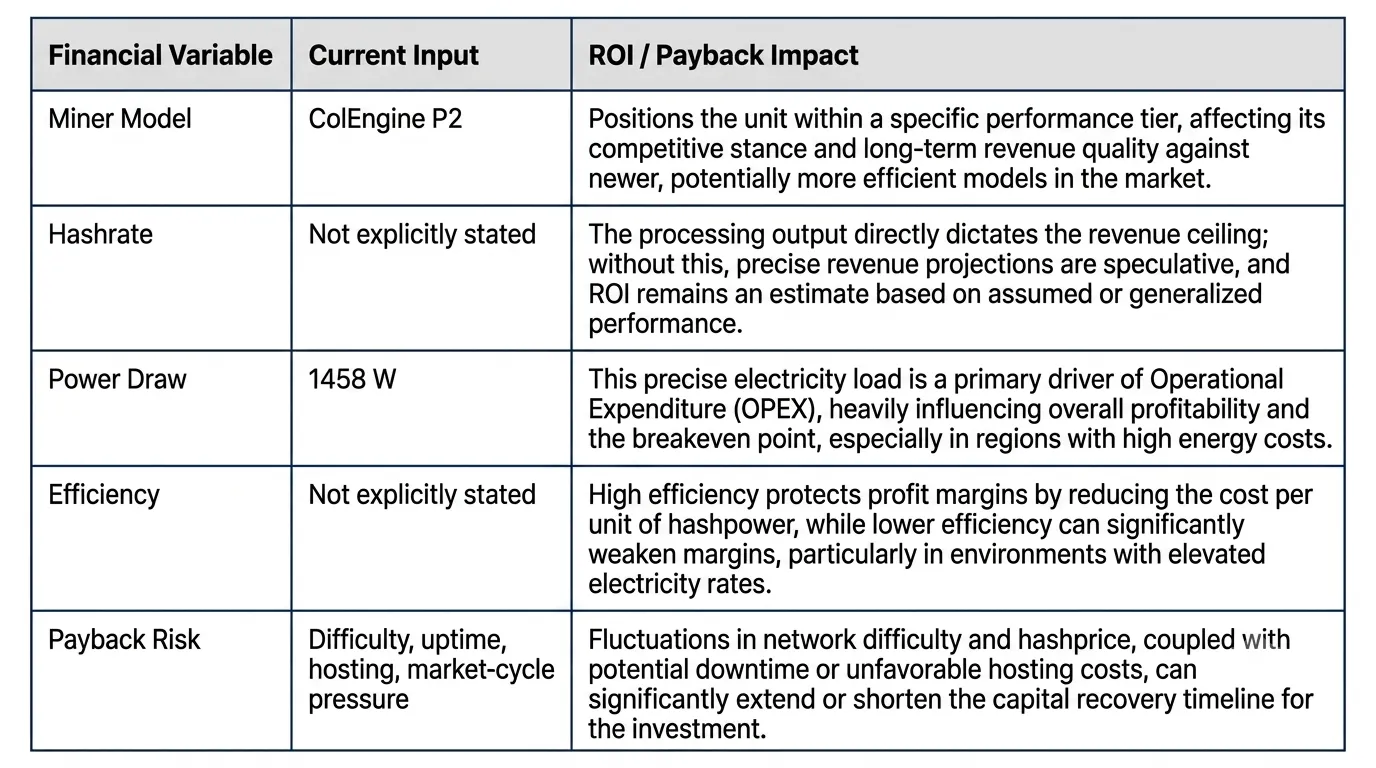
The matrix above highlights that while the 1458 W power draw of the ColEngine P2 provides a concrete figure for OPEX modeling, the lack of explicit hashrate and efficiency metrics introduces a degree of uncertainty into definitive revenue forecasting. This emphasizes the necessity of obtaining comprehensive performance data to conduct a truly robust ROI analysis. The miner's competitive positioning, its specific algorithm's market dynamics, and the prevailing network conditions will collectively determine the quality of its revenue streams and the duration of its capital payback cycle.
Macro-to-Micro Payback Pressure
In the absence of specific macro market triggers, such as significant legislative changes, new AI compute convergence narratives, or major ETF flows directly impacting the ColEngine P2, the primary payback pressures remain firmly rooted in the intrinsic dynamics of the cryptocurrency mining ecosystem. These include the inherently cyclical nature of hashprice, which can experience rapid and substantial fluctuations driven by shifts in demand and supply for the underlying digital asset. Concurrently, the relentless increase in network difficulty, a constant feature of mature mining networks, means that as more powerful and numerous machines come online, the ColEngine P2's proportionate share of block rewards may diminish, directly compressing profitability and extending the expected payback period.
Furthermore, regional electricity rate pressures, often influenced by broader geopolitical events, energy policy shifts, or seasonal demand, translate directly into heightened OPEX for the ColEngine P2. A sudden or sustained increase in energy costs can rapidly erode profit margins, potentially pushing the unit below its breakeven point and fundamentally altering the financial viability and payback trajectory. Hosting markups, risks of downtime due to infrastructure failures or maintenance, and the inherent resale risk of specialized hardware in a rapidly evolving technological market all contribute to the micro-level financial uncertainty that operators of the ColEngine P2 must meticulously account for.
Payback Verdict & Next Steps
The ColEngine P2, with its clearly defined 1458 W power consumption, offers a valuable, though incomplete, foundation for financial analysis. While this precise power draw facilitates accurate electrical cost modeling, the absence of specific hashrate and efficiency metrics means that a definitive ROI or payback verdict cannot be rendered without further operational performance data. Prospective investors must recognize that profitability is acutely sensitive to both the cost of electricity and the prevailing market hashprice. A comprehensive financial assessment therefore necessitates understanding these missing performance indicators to project revenue accurately. For a bespoke financial model tailored to your specific operational environment, or to validate procurement decisions and explore deployment options for the ColEngine P2, contact JingleMining for expert consulting and solutions.
Frequently Asked Questions (FAQ)
Q: How does the 1458 W power draw impact overall profitability?
A: The 1458 W power draw is a direct determinant of the electricity cost component within your operational expenses. Higher electricity rates per kilowatt-hour will significantly reduce profitability and extend the payback period, making energy-efficient operations and competitive power tariffs crucial.
Q: What factors contribute most to payback risk for the ColEngine P2?
A: Key factors influencing payback risk include fluctuations in the target cryptocurrency's market price (hashprice), continuous increases in network mining difficulty, the stability and uptime of your power and network infrastructure, and the prevailing costs of electricity or professional hosting services.
Q: Can JingleMining help with a customized ROI calculation for the ColEngine P2?
A: Yes, JingleMining offers expert consulting services to assist in developing a custom ROI model specific to your operational context. We can help with procurement validation and deployment consulting, integrating your unique electricity costs and market assumptions for a comprehensive financial outlook.