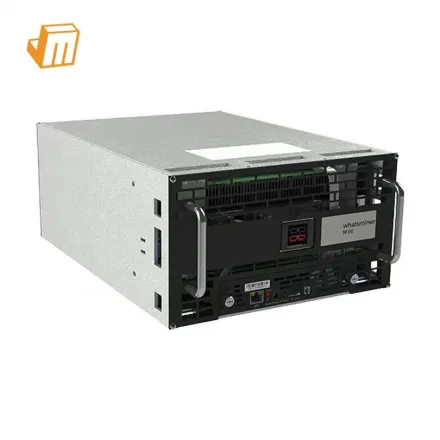

Revenue Assumption Baseline
The MicroBT WhatsMiner M66+ stands as a formidable contender in the SHA-256 mining landscape, boasting a substantial hashrate of 318 Terahashes per second (Th/s) with a power consumption of 5406 Watts and an efficiency rating of 17.00 W/TH. These core specifications form the fundamental baseline for any revenue projection. The raw hashing power of 318 Th/s directly dictates the machine's capacity to contribute to the Bitcoin network and, consequently, its share of block rewards. While the actual daily revenue is a dynamic variable influenced by the fluctuating Bitcoin price and the ever-increasing network difficulty, the M66+'s robust output establishes a high ceiling for potential earnings, positioning it as a significant revenue generator within a well-managed operation.
Beyond sheer hashrate, the efficiency of the M66+ at 17.00 W/TH is a critical determinant of its long-term profitability and revenue quality. This metric quantifies how effectively the miner converts electrical energy into computational power, directly impacting the operational expenditure (OPEX) associated with electricity costs. In an environment where energy prices are a primary cost driver, superior efficiency acts as a protective layer, safeguarding profit margins against potential price dips or increases in network difficulty. By minimizing the energy required per terahash, the M66+ enhances net revenue, ensuring that a larger portion of the gross earnings translates into actual profit, thereby improving the sustainability and attractiveness of the investment.
Strategic ROI Matrix
Evaluating the MicroBT WhatsMiner M66+'s investment viability requires a granular look at how its inherent specifications interact with external market forces to shape its Return on Investment (ROI) and payback period. This matrix dissects key financial variables, illustrating their direct impact on the miner's economic performance in a dynamic market.
| Financial Variable | Current Input | ROI / Payback Impact |
|---|---|---|
| Miner Model | MicroBT WhatsMiner M66+ | High-performance, modern ASIC positioning affects revenue quality by ensuring competitive block reward share. |
| Hashrate | 318Th/s | High output directly raises the potential revenue ceiling, accelerating capital recovery under favorable conditions. |
| Power Draw | 5406 W | Significant electricity load directly influences OPEX; lower power rates are crucial for maintaining healthy margins and improving ROI. |
| Efficiency | 17.00 W/TH | Competitive efficiency protects profit margins against rising electricity costs and increasing network difficulty, shortening payback. |
| Payback Risk | Difficulty, uptime, hosting, or market-cycle pressure | Fluctuations in network difficulty, unforeseen downtime, varying hosting fees, and broader market volatility can significantly extend or shorten the capital recovery time. |
The WhatsMiner M66+'s high hashrate of 318 Th/s provides a substantial advantage in securing a share of Bitcoin block rewards, directly impacting its revenue potential. However, this robust output comes with a considerable power draw of 5406 W, making electricity costs a dominant factor in operational expenditure. The machine's efficiency of 17.00 W/TH is competitive for its class, offering a buffer against rising energy prices and network difficulty, which are critical for protecting profit margins and influencing the payback period. Ultimately, the interplay between these fixed technical specifications and volatile external factors like market price, network difficulty, and hosting stability dictates the true duration of capital recovery and the overall ROI.
Macro-to-Micro Payback Pressure
Recent observations, such as increased Bitcoin miner inflows to exchanges like Binance and the struggle for BTC to maintain an uptrend, translate directly into tangible financial pressures for WhatsMiner M66+ operators. A surge in miner inflows often signals an increase in global mining capacity, which inevitably leads to a higher network difficulty. For an individual M66+ unit, this means its fixed 318 Th/s hashrate will capture a smaller proportion of the overall block rewards, effectively reducing daily revenue unless offset by a proportional increase in Bitcoin price. If BTC simultaneously struggles to hold an uptrend, as suggested by market sentiment, the hashprice—the revenue generated per terahash—will face downward pressure, directly extending the payback period for new M66+ investments and tightening operating margins for existing ones.
The speculative question of whether Bitcoin can reach 70K, juxtaposed with its current struggle, highlights a period of significant market volatility. While a move towards 70K would undeniably boost revenue for M66+ miners, the "struggle to hold uptrend" implies periods of price stagnation or dips, which can rapidly erode profitability, especially for operations with higher electricity costs. In such an environment, the M66+'s 17.00 W/TH efficiency becomes paramount, acting as a crucial defense mechanism against hashprice compression. Operators must meticulously manage their electricity rates and ensure maximum uptime, as even minor fluctuations in market price or energy costs can dramatically alter the break-even point and prolong the time required to recoup the initial investment in this high-performance ASIC.
Payback Verdict & Next Steps
The MicroBT WhatsMiner M66+ presents a compelling investment for serious SHA-256 miners due to its high hashrate and competitive energy efficiency. However, its ultimate ROI and payback period are deeply intertwined with the unpredictable dynamics of the Bitcoin market, including network difficulty trends, BTC price volatility, and the overarching macroeconomic landscape. While the M66+ is engineered for robust performance, the current market environment, characterized by miner inflows and price uncertainty, necessitates a disciplined approach to financial modeling and operational management. Investors must factor in potential shifts in hashprice and electricity costs to accurately forecast profitability and ensure a sustainable mining venture.
To navigate these complexities and optimize your investment in the MicroBT WhatsMiner M66+, we strongly recommend engaging with JingleMining's experts. Our team can provide a custom ROI model tailored to your specific energy costs and deployment strategy, validate your procurement decisions, and offer comprehensive consulting for seamless and profitable deployment. Visit the JingleMining website to explore how we can help you maximize the financial potential of your mining operation.
Frequently Asked Questions (FAQ)
Q: How does the M66+'s efficiency impact its payback period?
A: The M66+'s 17.00 W/TH efficiency directly reduces operational electricity costs per unit of hashrate. This lower OPEX means that more of the generated revenue contributes to profit, allowing the initial investment to be recouped faster, especially in environments with stable or rising electricity prices.
Q: What are the main external risks affecting the M66+'s ROI?
A: The primary external risks include fluctuations in Bitcoin's market price, increases in network difficulty due to growing global hashrate, and changes in electricity rates. Unforeseen downtime, hosting facility stability, and regulatory shifts can also significantly impact overall return on investment.
Q: Can market volatility negate the benefits of the M66+'s high hashrate?
A: Yes, significant market volatility, particularly extended periods of low Bitcoin prices or rapid increases in network difficulty, can substantially diminish the profitability derived from the M66+'s high hashrate. While its raw power offers a strong earning potential, these external factors can extend the payback period and reduce the overall ROI if not properly managed through strategic operational planning.