
The infrastructure securing decentralized cryptographic ledgers operates in a state of relentless progression. Institutional capital allocators are continuously forced to balance raw computational output against electrical expenditure, hardware depreciation, and environmental variables. While alternative cooling methodologies frequently capture headlines, the absolute backbone of the global SHA-256 network remains heavily anchored in advanced, industrial-grade air-cooled systems. These systems deliver uncompromised reliability across a radically diverse range of global climates and infrastructure setups, requiring significantly lower initial capital expenditure for facility retrofitting.
Surviving subsequent network difficulty adjustments and programmed block reward reductions requires equipment that refuses to yield under continuous, maximum-load stress. This comprehensive technical and economic analysis dissects one of the most formidable air-cooled machines currently deployed in the global hashrate market, exploring its internal engineering, financial viability, and strategic placement within modern high-density data centers.
The Evolution of Advanced Air-Cooled Infrastructure 🌪️
The physical construction and internal semiconductor architecture of cryptographic hardware dictate its long-term viability. Equipment manufacturers must engineer devices capable of withstanding extreme thermal loads, acoustic vibrations, and continuous 24/7 operation without suffering from rapid degradation. The transition to highly advanced nanometer silicon has forced a complete reimagining of heat dissipation, power delivery, and structural integrity.
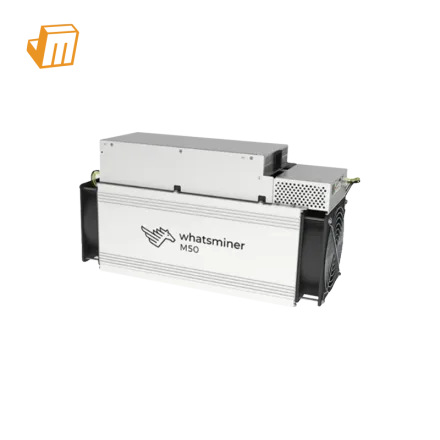
MicroBT engineers devices renowned for heavy-duty, industrial-grade build quality, prioritizing absolute uptime over fragile aesthetic designs. At the core of this specific architecture lies a highly dense array of custom-fabricated semiconductors. This specific node reduction accelerates the volume of cryptographic hashes generated per second while simultaneously minimizing the severe electrical leakage that notoriously plagues older silicon. Electrical leakage directly translates to parasitic heat, meaning precision fabrication allows the machine to run significantly cooler while producing substantially more computational output.
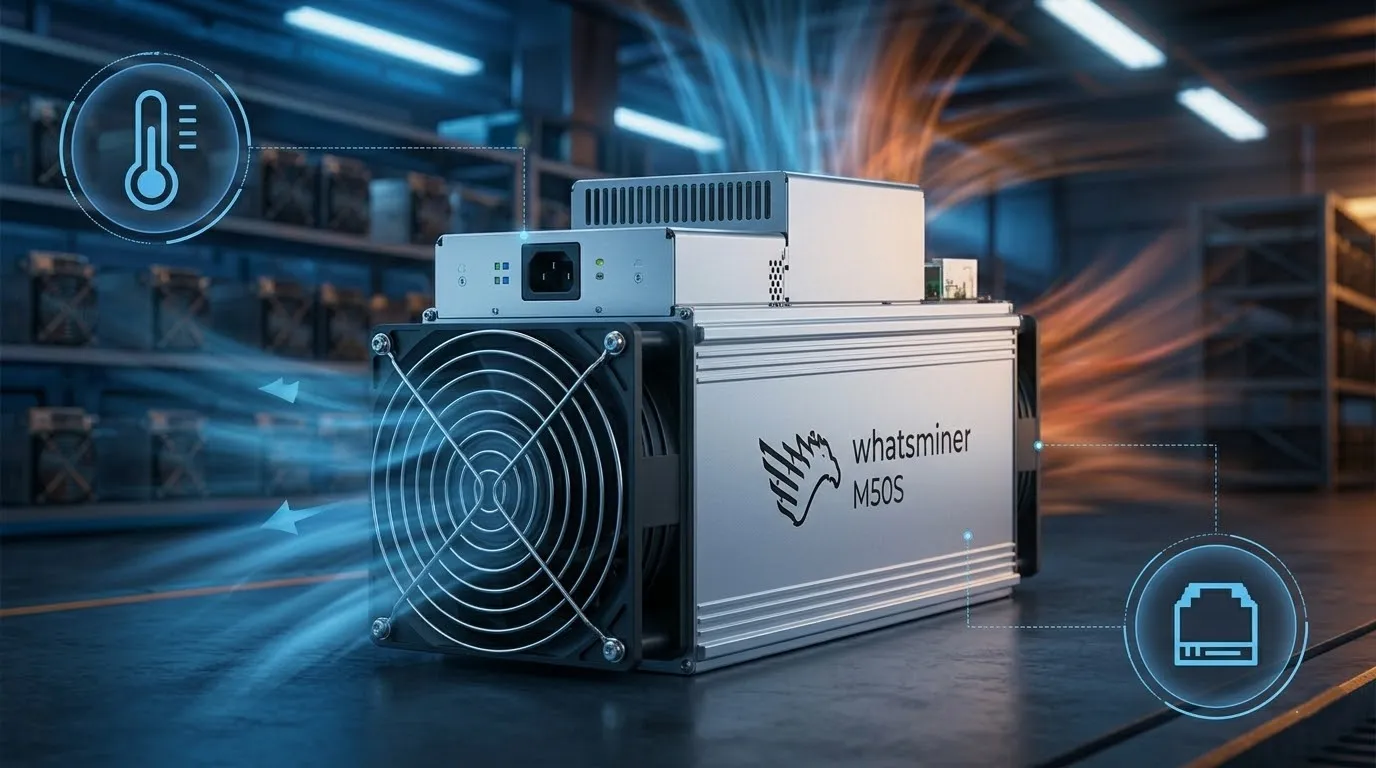
Surrounding these advanced chips is a strictly utilitarian thermal management system. The architecture utilizes direct-contact aluminum heat sinks extruded with precision-angled fins to maximize the total surface area exposed to passing air. High-velocity intake and exhaust fans push massive volumes of ambient air directly through these channels, stripping thermal energy from the hashboards with extraordinary brute-force efficiency. Furthermore, the exoskeleton is constructed from rigid, heavy-gauge metal alloys designed to withstand the intense acoustic vibrations and physical stress inherent in large-scale deployments. This uncompromising ruggedness ensures internal components remain securely seated and fully operational even when deployed in suboptimal, harsh atmospheric conditions.
Analyzing the Whatsminer M50S Power Consumption Profile ⚡
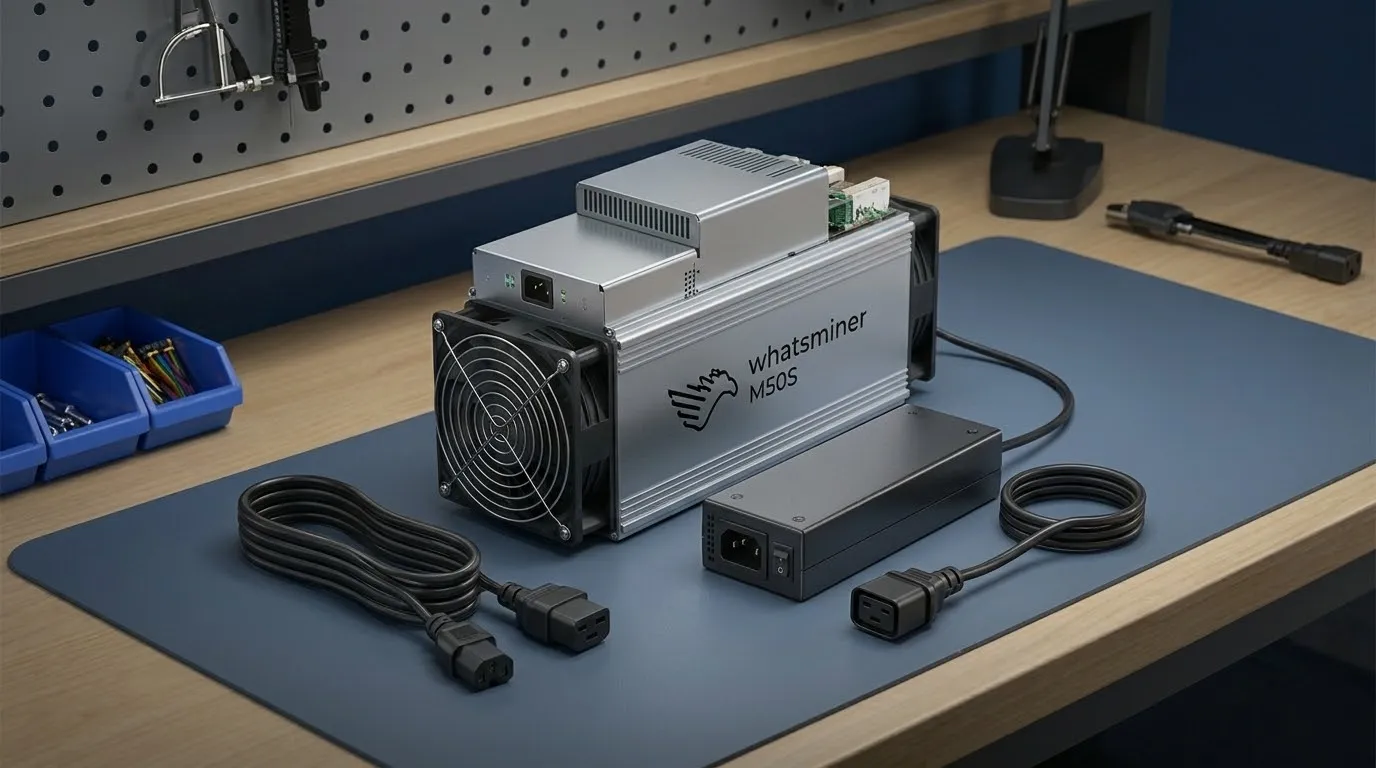
Understanding the exact electrical draw and voltage regulation of high-performance silicon is the absolute bedrock of institutional infrastructure planning. The Whatsminer M50S power consumption profile is dictated by its customized, fully integrated power supply unit. MicroBT utilizes a highly specific, flattened PSU design that mounts seamlessly against the top of the chassis. This integrated approach optimizes the overall physical footprint of the unit, allowing for tighter rack density, and critically improves internal airflow pathways by removing external cabling obstructions that would otherwise cause aerodynamic drag.
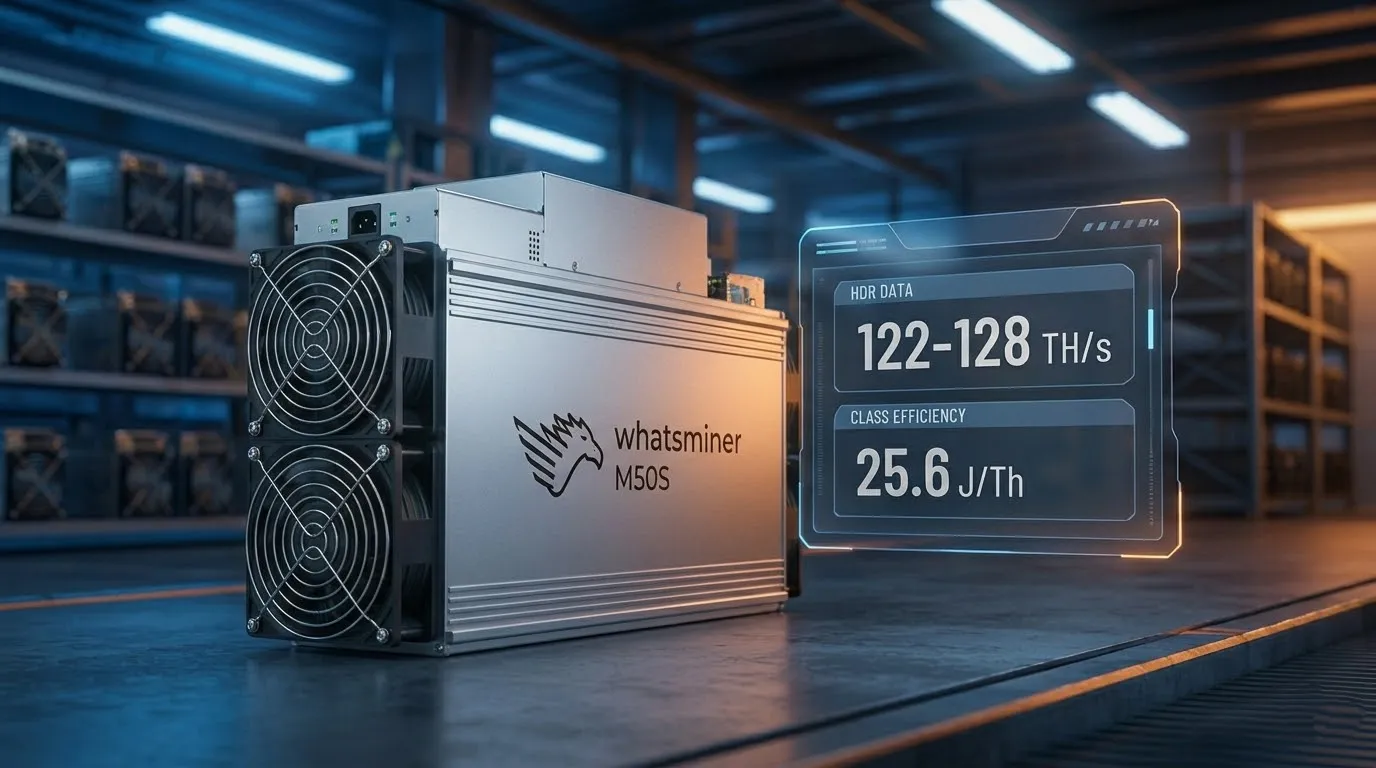
This power supply is engineered with advanced internal rectifiers capable of accepting wide-voltage inputs, providing crucial flexibility for facilities operating across different global electrical grids and varying three-phase configurations. The relationship between raw power draw and computational output defines the fundamental efficiency ratio of the machine, establishing an incredibly competitive metric of approximately 26 joules per terahash. By leveraging the advanced silicon architecture, the device translates high-voltage alternating current into stabilized direct current with incredibly low conversion loss.
This high-tier efficiency means that the vast majority of the electricity procured from the local grid is utilized strictly for executing cryptographic hashing algorithms rather than being wasted as excess heat. Infrastructure architects must design their electrical panels, step-down transformers, and power distribution units to handle the continuous, unyielding maximum loads required by these machines. The stability of the power delivery directly impacts the longevity of the hashboards; even minor voltage fluctuations or micro-surges can degrade sensitive silicon over time. Therefore, the robust internal regulation of this specific machine acts as a critical defensive buffer, protecting the delicate logic gates from external grid instability and dirty power.
Evaluating Institutional Whatsminer M50S Profitability and ROI 💹
Deploying capital in the cryptographic hardware sector requires rigorous financial modeling based on empirical field data rather than speculative, top-of-funnel forecasting. Whatsminer M50S profitability is continuously shaped by the intersection of three highly dynamic macroeconomic metrics: the mathematical difficulty of the global network, the programmed block reward schedule, and localized energy procurement costs.
Because this hardware operates with a highly competitive 26 J/TH energy efficiency ratio, it maintains a remarkably strong defensive posture against sudden, aggressive surges in network difficulty. When global network participation increases and the cryptographic puzzle becomes exponentially harder to solve, older and less efficient machines rapidly cross the threshold into unprofitability, forcing facility operators to unplug them to avoid operating at a loss. The advanced efficiency of this architecture allows it to remain comfortably above the profitability baseline during these volatile market contractions and prolonged bear cycles.
The sheer density of the hashrate generated ensures a consistent, mathematically predictable capture of block rewards. Over an extended operational timeline, the ability to keep machines hashing while competitors are forced to power down leads to a massive accumulation of capital. To accurately map out projected yields, stress-test various extreme energy cost scenarios, and monitor real-time global network conditions, utilizing an advanced and dynamically updated ASIC miner profitability tracker is absolutely crucial for maintaining a disciplined, institutional-grade financial strategy.
Strategic Capital Allocation: Decoding the Whatsminer M50S Price 📉
Procuring industrial-grade computing power is fundamentally an exercise in maximizing the long-term return on deployed capital. The Whatsminer M50S price reflects its status as a highly durable, enterprise-ready infrastructure asset. When evaluating the total acquisition cost, the financial analysis must extend far beyond the immediate upfront invoice. The true economic value of this specific hardware is unlocked through its proven extended lifecycle, drastically minimized maintenance requirements, and zero-downtime operational capability.
Because the chassis and internal components are heavily fortified against physical degradation, thermal warping, and vibration damage, the depreciation schedule of this machine is significantly elongated compared to more fragile alternatives. This durability means the asset continues to generate positive cash flow over a much longer time horizon, heavily diluting the initial capital expenditure across thousands of hours of uninterrupted operation. The high terahash output combined with lower wattage requirements essentially guarantees a faster path to returning the initial capital invested.
Furthermore, the standardized physical form factor allows for rapid, seamless deployment within existing hot-aisle/cold-aisle data center configurations without requiring expensive, customized shelving or proprietary cooling infrastructure retrofits. The machines slide perfectly into standard racking systems, streamlining deployment labor and minimizing downtime during facility upgrades. For capital allocators prioritizing the absolute highest efficiency metrics and maximum density per square foot within an air-cooled framework, securing the MicroBT Whatsminer M50S provides the ultimate, uncompromising edge. Partnering with a verified, direct-to-institution distributor like Jingle Mining ensures totally transparent pricing structures, secure global logistics, and access to critical post-purchase engineering support.
Infrastructure Architecture: Whatsminer M50S vs Antminer S23 Hyd 3U ⚖️
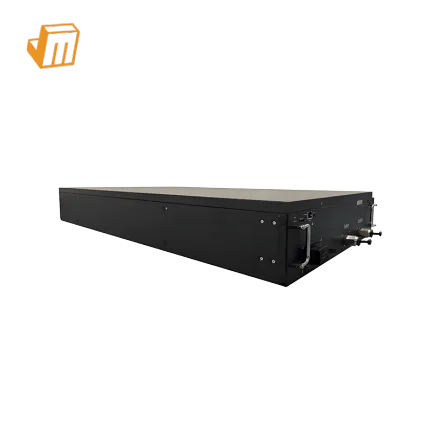
Establishing definitive technical superiority and determining the optimal deployment path requires a direct confrontation between the leading architectures currently available on the market. When analyzing the strategic differences in the Whatsminer M50S vs Antminer S23 Hyd 3U, the diverging engineering philosophies and deployment suitabilities become starkly apparent. This comparison highlights the core debate in modern facility design: optimized air cooling versus ultra-dense hydro cooling.
The S23 Hyd 3U represents the absolute pinnacle of liquid-cooled density, generating a staggering 580 terahashes from a single 3U rack-mounted unit. It offers superior joules-per-terahash efficiency and entirely eliminates ambient noise and dust ingress. However, deploying the S23 Hyd mandates an immensely high initial capital expenditure to build out the required closed-loop liquid infrastructure, massive external dry coolers, and specialized three-phase high-voltage power distribution networks. It is a highly complex ecosystem designed strictly for newly built, purpose-engineered facilities.
Conversely, the primary advantage of the M50S architecture lies in its legendary environmental resilience and deployment flexibility. While it cannot match the raw per-unit output of a hydro-cooled flagship, the M50S completely bypasses the need for multi-million-dollar liquid cooling infrastructure. It can be rapidly deployed into nearly any existing data center utilizing traditional hot-aisle/cold-aisle containment. The incredibly robust heat sink design and exceptionally rigid chassis of the MicroBT unit provide a massive margin of error for facilities that operate in high-humidity zones, desert climates, or environments lacking laboratory-grade atmospheric control.
From a financial perspective, the barrier to entry and the cost per deployed megawatt are significantly lower with the M50S. It presents a vastly superior long-term value proposition for deployments that prioritize rapid scaling, capital flexibility, and uncompromising uptime with minimal infrastructure complexity. To conduct exact, side-by-side metric evaluations based on real-time market pricing, hash output, and electrical efficiency, leveraging a dedicated, institutional miner comparator guarantees highly accurate, data-driven procurement decisions.
Field Diagnostics: Unpacking Whatsminer M50S Bitcoin Miner Reddit Consensus 🌐
Manufacturer specifications and controlled laboratory testing provide essential baseline metrics, but genuine hardware viability is proven strictly on the data center floor. Analyzing the broader, unfiltered community consensus—particularly the deeply technical Whatsminer M50S bitcoin miner reddit threads and dedicated ASIC engineering forums—reveals crucial, actionable insights into the long-term operational realities of this hardware.
The overwhelming consensus from large-scale deployment managers and independent facility operators highlights the absolute plug-and-play reliability of the MicroBT hardware. The proprietary firmware is repeatedly praised across these networks for its unyielding stability. It actively avoids the frequent crashing, hashboard dropping, or endless reboot loops that sometimes plague other manufacturers after sudden facility power losses or momentary network disconnects. This firmware resilience translates directly to higher operational uptime and mathematically higher profitability.
The automated tuning capabilities of the firmware ensure that the machine rapidly finds its optimal frequency and voltage state immediately upon booting, minimizing the costly time spent hashing below peak capacity. Technical discussions also frequently center on the extreme durability of the high-RPM cooling fans. While they generate intense acoustic volume—a mandatory physical requirement for moving such vast quantities of air through dense heat sinks—they rarely suffer from the premature bearing failures common in cheaper components, ensuring continuous, aggressive heat dissipation month after uninterrupted month.
Architecting the Optimal Air-Cooled Deployment Ecosystem 🌍
Procuring the hardware itself is merely the acquisition phase; realizing its maximum financial potential requires an immaculately designed surrounding infrastructure. Deploying these advanced air-cooled units at an institutional scale demands a total mastery of atmospheric thermodynamics, large-scale electrical engineering, and precise airflow management.
The absolute defining feature of a highly profitable air-cooled deployment is the flawless implementation of strict hot-aisle/cold-aisle containment. This architectural design completely and physically segregates the chilled, filtered intake air from the superheated, low-density exhaust air. If exhaust air is allowed to bypass containment and recirculate back into the intake manifolds of the machines, the hardware will rapidly overheat. This triggers severe thermal throttling, instantly degrading hash output and destroying projected profitability. The facility must utilize massive industrial intake louvers, heavy-duty exhaust fans, and perfectly sealed evaporative cooling walls to maintain massive negative air pressure in the hot aisle, forcefully pulling the heat out of the building faster than the machines can physically generate it.
Electrical infrastructure must be built with absolute zero tolerance for degradation or failure. Standard commercial or light-industrial wiring is entirely insufficient for this operational density. Facilities require massive, dedicated step-down transformers, specialized high-voltage three-phase power distribution panels, and heavy-gauge copper wiring rated for continuous, maximum-capacity thermal loads without suffering from voltage drop. Proper deep earth grounding and advanced surge protection are mandatory to protect the highly sensitive silicon from sudden grid anomalies or lightning strikes. To ensure all environmental, structural, and electrical parameters are flawlessly executed prior to powering on a single unit, comprehensively reviewing an advanced ecosystem guide is a strictly mandatory step for infrastructure architects.
Finally, the massive, aggregated cryptographic power generated by the facility must be routed with absolute precision to ensure zero-latency block processing and consistent revenue capture. Selecting a global network node with a proven history of uptime, ultra-low latency server routing, and highly transparent payout structures is non-negotiable. Directing the facility's total output to a tier-one, deeply established institution like f2pool guarantees that every single valid hash generated by your hardware translates directly into secured, verifiable capital.
Frequently Asked Questions (FAQ) ❓
Q: What specific electrical modifications are required to deploy this hardware at an institutional scale?
A: Scaling this architecture requires uncompromising, industrial-grade electrical engineering. These units draw massive, continuous wattage, necessitating robust three-phase power systems. Facilities must install dedicated multi-megawatt step-down transformers, heavy-duty switchgear, and highly intelligent Power Distribution Units equipped with high-amperage, temperature-rated breakers. Standard residential or light-commercial electrical panels will immediately overload, trip, and present a severe fire hazard. Every single inch of wiring must be rated for continuous, 24/7 maximum load operation without suffering from thermal degradation.
Q: How critical is industrial air filtration in a high-density data center environment?
A: Air filtration is the primary, non-negotiable defense mechanism for extending hardware longevity. Because the dual cooling fans push massive volumes of air through the internal heat sinks every single minute, atmospheric dust, pollen, high humidity, or industrial particulate will rapidly accumulate directly on the silicon boards. This thick accumulation acts as a thermal blanket, trapping intense heat and eventually causing localized chip failure or electrical short circuits. Facilities must implement rigorous, multi-stage filtration banks on their intake walls to ensure only highly purified air enters the cold aisle, drastically extending the lifespan of the hashboards.
Q: Can the extreme heat generated by these machines be effectively repurposed for other commercial operations?
A: Yes, industrial heat recovery is a rapidly expanding, highly lucrative strategy for air-cooled operations. The superheated exhaust air expelled into the contained hot aisle can be effectively directed through specialized air-to-water heat exchangers or massive insulated ducting systems. This massive volume of thermal energy is frequently repurposed for heating commercial agricultural greenhouses, providing large-scale space heating for adjacent industrial warehouses, or fueling continuous industrial biomass drying processes. This effectively creates a secondary revenue stream that heavily subsidizes the initial electrical cost of the cryptographic deployment.
Q: What is the realistic expected lifespan of this specific hardware generation under continuous load?
A: The highly robust physical construction, heavy-metal chassis, and advanced silicon architecture provide a significantly extended operational runway compared to older hardware generations. Assuming the facility operator maintains strict atmospheric thermal control, provides pristine air filtration, and delivers perfectly stable, fluctuation-free voltage, the hardware is engineered to run continuously at maximum capacity for multiple years. The actual retirement of the machine is almost always dictated by the economics of the global network difficulty rather than physical hardware failure; the heavily fortified structure will likely remain sound and capable of hashing long after subsequent generations of silicon make it mathematically obsolete.
Final Verdict: Cementing Your Cryptographic Legacy 🏆
The execution of a highly profitable, resilient infrastructure deployment requires hardware that perfectly balances raw computational violence with unyielding physical durability. The historical margin for error in capital allocation has been completely eradicated by the hyper-competitive nature of the global network. Surviving extreme market volatility, deep bear cycles, and programmed network halving adjustments demands equipment that will never falter under continuous, maximum-load stress.
This comprehensive analysis clearly establishes the MicroBT architecture as a definitive, enterprise-grade asset. By masterfully combining highly efficient 26 J/TH silicon with an industrial chassis built specifically to withstand the harshest, most unforgiving data center environments on earth, it provides a highly secure, heavily fortified foundation for large-scale capital deployment.
The strategic investment required to secure this tier of computational power is immediately justified by the extreme reliability, minimal maintenance overhead, and extended operational lifecycle of the units. Utilizing this heavily fortified air-cooled architecture ensures your facility maintains a dominant, aggressively defensive posture against unpredictable network fluctuations. To maximize your spatial density per square foot, entirely minimize hardware failure rates, and aggressively capture block rewards without interruption, integrating this specific technological standard is the definitive, uncompromising strategy for long-term cryptographic success.