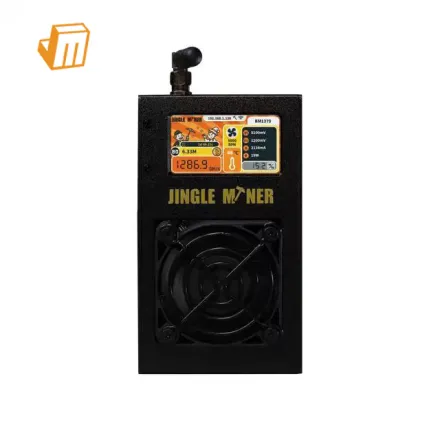
A hardware specification can help a reader decide whether Jingle Miner BTC Solo Lite belongs on a shortlist for a solo-mining setup. It cannot establish a regular income or a verified chance of finding a block over a chosen period. Before estimating outcomes, record the selected method, its dated network inputs, the observation duration and operating assumptions. An income assessment also needs the applicable pool payout terms and cost records. Readers comparing documented hardware capabilities can use the product information below. A reader who needs predictable receipts to cover a bill or repay a purchase should defer that financial conclusion until the relevant outcome and cost evidence is available.
Keep the hardware decision separate from the outcome estimate. Record the exact model and the version of the product information being used. Then identify the question you are trying to answer: whether the documented hardware meets a setup requirement, whether a specific pool accepts the device, or how an explicitly defined probability model behaves under dated network conditions. Evidence for one question does not automatically answer the others. This distinction lets a reader continue a useful hardware comparison while leaving an unsupported income prediction unresolved. For a separate public discussion of this reader task, see ASIC model names are not enough: a variant verification guide.

What the product record establishes
The supplied product record for Jingle Miner BTC Solo Lite states: algorithm: SHA-256d; hashrate: 1.20 Th/s; power specification: 23w. Keep these values attached to this exact model. A listed rating is documentary evidence, not an independent measurement of the delivered unit. In particular, the power specification is not proof of a constant draw or a guaranteed maximum. Compare measurements only after recording their operating conditions and observation period. A second independently useful field reference is Antminer Z15 Pro: power cost and site readiness checklist.
The accessory description is recorded as “Yes; 5V5A Power Cable(Includes US, EU, UK, AU Adapters); USA - Power Cord”. Retain that description when checking the package and order. A cable or regional plug description does not establish an adapter nameplate, usable output capacity, device current demand or mains-input compatibility. Check the physical component labels and the device instructions separately. If a marking has an uncertain component owner, ask the supplier which item it describes instead of transferring that marking to another component.
The record marks the power-supply inclusion field as “Yes”. This records the stated package scope; it is not an electrical compatibility approval or proof that a particular unit has been tested. Resolve discrepancies between the listing, order and delivered package before energizing the device.
The connection entry is “Wi-Fi”. Match that description to your actual setup, then check the device instructions for configuration. An interface description does not establish that a particular pool endpoint is reachable or that a firmware version supports it.
Separate hashing capacity from a probability estimate
Solo mining does not turn a hardware rating into a payment schedule. Finding a valid block is a probabilistic outcome, so an observation period can end without a reward. A statement about the device’s hashing capacity is therefore different from a statement about the chance of a reward within a specified window. Do not turn a short successful demonstration, an accepted share or a screenshot of activity into a verified future win probability.
Choose the estimation method before collecting inputs. A method comparing device and network hashrates requires matching rate units and a dated network estimate. A difficulty-based method uses difficulty as an input to its documented calculation; difficulty is not a total hashrate in which the device owns a percentage. Follow the requirements of the chosen method rather than insisting that both inputs are always necessary or dividing unlike quantities simply because both are available.
Record the intended observation duration, the source and date of each input, and any assumptions about operation during that window. A historical figure can describe a historical scenario; it does not automatically describe current conditions. If the purpose is a current estimate, check whether the inputs still apply and show how a changed assumption affects the result. If the necessary network evidence or duration is missing, report that the probability remains unverified instead of assigning a convenient number.
Product-listing evidence checked on 2026-11-20 (UTC).
Frequently Asked Questions (FAQ)
Does the listed hashrate establish daily income or a block-win probability?
No. The listed hashrate alone establishes neither daily income nor the probability of finding a block within a specified period. It describes documented hashing capacity, not the network conditions, observation duration, payout policy or a guaranteed reward. Use a stated estimation method and dated inputs for a probability scenario. To discuss income, also identify the actual payout terms and applicable costs; a probability estimate is not cash received.
Can matching the SHA-256 algorithm alone establish firmware, pool or other-network compatibility?
No. An algorithm label is not a complete compatibility statement. Verify the exact firmware and pool requirements with the relevant documentation. A listed coin neither proves support for every network using a related algorithm nor proves that every other network is unsupported. Keep any unverified compatibility conclusion open until the relevant product or pool evidence resolves it.
What should I record before comparing two solo-mining outcome estimates?
Record the method, hardware input, network input source and date, observation duration and operating assumptions. Compare estimates under the same conditions before attributing a difference to the miner. If the methods or observation periods differ, keep those differences visible instead of treating the results as directly comparable.
Checks before a trial or a financial decision
Before a trial, obtain the instructions for the exact device and firmware version, then confirm the chosen pool’s connection and payout requirements. Keep the documented configuration with the order records. Do not assume a feature such as automatic failover, a particular protocol version or a supported operating mode merely because another miner offers it. Where the instructions and pool requirements disagree, clarify the discrepancy before relying on that setup.
Use the trial to record what actually happened: the observation window, operating interruptions, the displayed status and the pool’s corresponding records. An accepted share can help document communication and submitted work; it is not interchangeable with proof that a block has been found or a reward has been paid. Keep the original records when asking the supplier or pool to explain an unresolved result. Avoid assigning the discrepancy to a hardware fault, a network fault or an electrical limit without evidence.
A financial decision needs additional evidence beyond the hardware record: an applicable purchase quote, the actual delivery and setup costs, the relevant payout terms and dated assumptions for any outcome estimate. Separate known amounts from unresolved inputs and keep their periods and currencies consistent. A buyer can still compare documented hardware while those figures are missing, but cannot call the resulting income, profit or recovery date verified. The next useful step is to obtain the missing record, not to make the forecast look more precise.