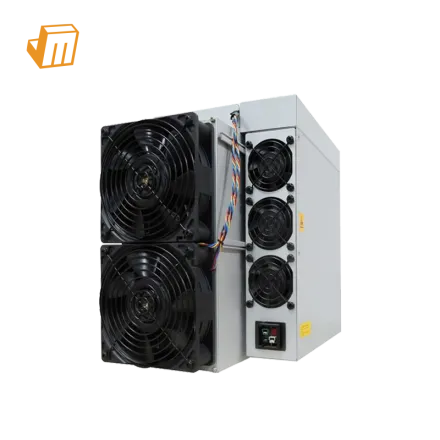

Revenue Assumption Baseline
The Bitmain Antminer K7 is engineered for dedicated mining on the Eaglesong algorithm, specifically targeting the Nervos (CKB) network. Its robust hashrate of 63.5 Th/s establishes a significant foundation for generating CKB block rewards. This raw computational power directly influences a miner's share of the network's distributed tokens. However, the conversion of these CKB tokens into tangible financial returns is contingent upon several dynamic factors, including the prevailing market price of CKB, the current network difficulty, and the efficiency of the chosen mining pool in aggregating and distributing rewards. A consistent CKB price and manageable network difficulty are crucial for translating the K7's high hashrate into predictable daily revenue.
Operating the Antminer K7 involves a power draw of 3080 W, which, combined with its 48.50 W/TH efficiency, dictates the operational expenditure (OPEX) through electricity costs. This efficiency rating is a critical metric for long-term profitability, as it indicates how effectively the miner converts electrical energy into hashpower. Any volatility in electricity rates directly impacts the net profit margins, potentially lengthening the payback period. Therefore, while the K7's hashrate defines its revenue ceiling, its power consumption and efficiency define the floor of its profitability, making a detailed understanding of energy costs paramount for any serious CKB mining operation.
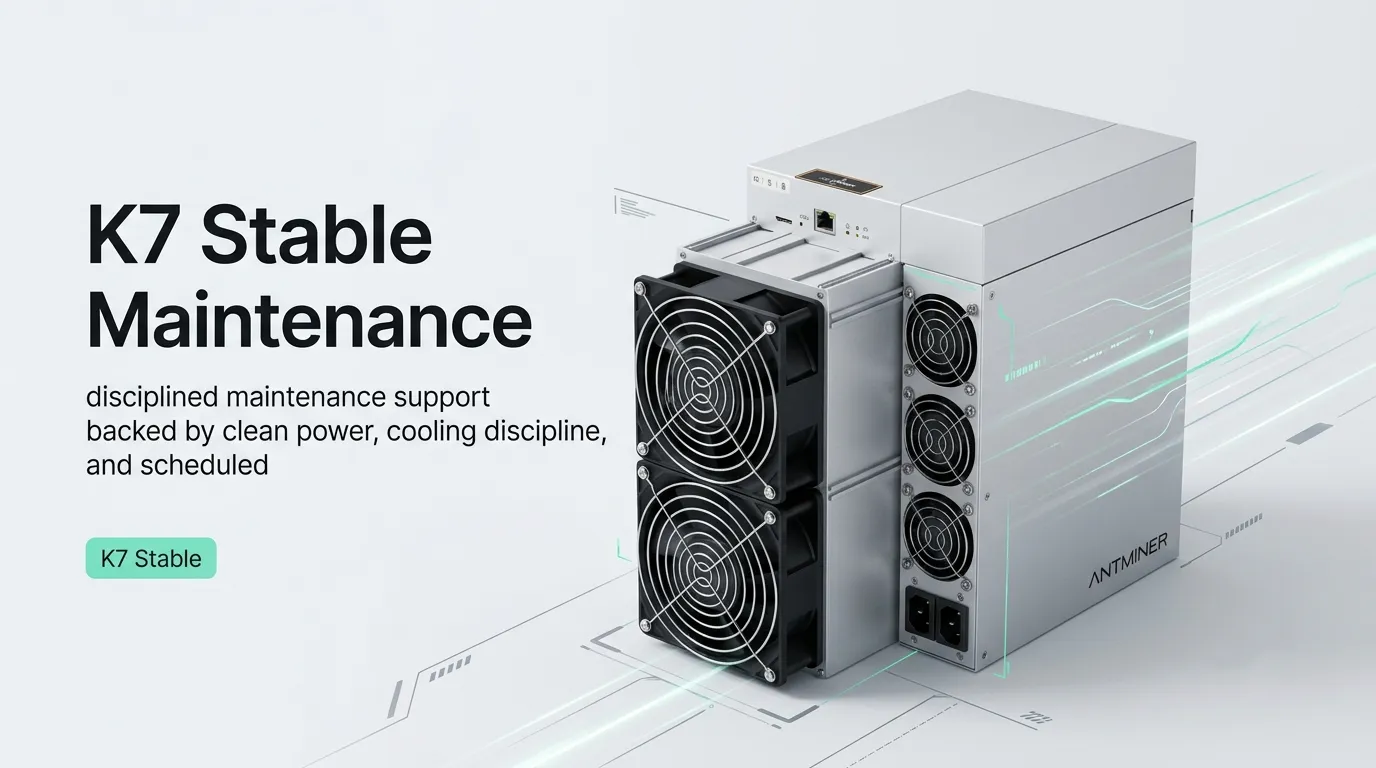
Strategic ROI Matrix
Assessing the financial viability of the Bitmain Antminer K7 requires a granular examination of its technical attributes against the backdrop of market forces. The following matrix illustrates the interplay between core financial variables and their direct influence on the investment's return and payback period.
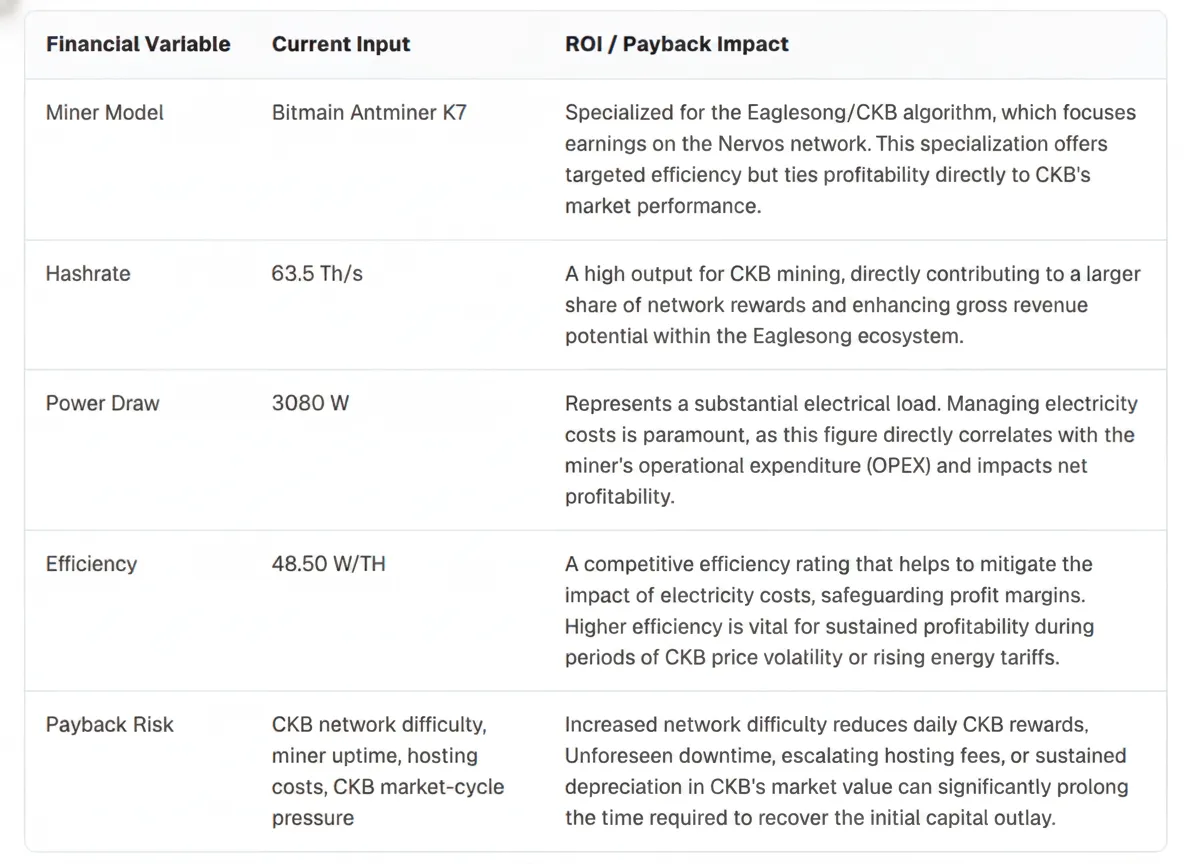
The analysis presented in this matrix highlights that the Antminer K7, with its 63.5 Th/s hashrate and 48.50 W/TH efficiency, is a formidable machine for Eaglesong (CKB) mining. Its dedicated design for the Nervos network offers a clear pathway to earning CKB. However, the 3080 W power draw makes the investment highly sensitive to electricity rates. Optimizing energy costs is not merely a recommendation but a necessity for achieving a favorable return on investment. The payback timeline will ultimately be a function of CKB's price trajectory, the evolving network difficulty, and the operational stability of the mining setup. Prudent financial planning requires a dynamic model that accounts for these fluctuating variables.
Macro-to-Micro Payback Pressure
Broader macroeconomic forces, while seemingly distant from a single ASIC miner, profoundly influence the Antminer K7's profitability and payback period for CKB. Global energy market shifts, for instance, such as spikes in oil and gas prices driven by geopolitical events or supply chain disruptions, directly translate into higher electricity costs for mining operations. For a machine drawing 3080 W, even a marginal increase in per-kilowatt-hour rates can significantly inflate daily OPEX, eroding the K7's 48.50 W/TH efficiency advantage and extending the time it takes to recoup the initial investment. This macro pressure on energy pricing can quickly turn a projected profitable venture into a financially strained one.
Furthermore, the overall sentiment in the wider cryptocurrency market, often influenced by regulatory developments, interest rate changes, or institutional investment trends, directly impacts the valuation of altcoins like CKB. A widespread market downturn, for example, can lead to a sustained depreciation in CKB's price, effectively reducing the dollar-denominated value of the tokens mined by the Antminer K7. Even if the K7 maintains its 63.5 Th/s output and continues to earn CKB at a consistent rate, a lower CKB market price means a longer period to reach the initial investment's break-even point. These macro market dynamics underscore the importance of a robust risk assessment that looks beyond immediate technical specifications.
Payback Verdict & Next Steps
The Bitmain Antminer K7 offers a powerful, specialized solution for Eaglesong (CKB) mining, delivering substantial hashrate and competitive efficiency. Its potential for revenue generation is clear, yet the path to a favorable payback is intricately linked to diligent management of its 3080 W power consumption and a strategic approach to CKB's market volatility. Success hinges on securing cost-effective electricity, navigating the dynamic CKB network difficulty, and ensuring maximum operational uptime. Without these elements, the capital recovery timeline can become protracted.
To gain a precise, customized understanding of the Antminer K7's ROI potential within your specific operational context, contact JingleMining. Our team provides expert-driven ROI modeling, assists with procurement validation, and offers comprehensive deployment consulting to optimize your investment and accelerate your payback timeline.
Frequently Asked Questions (FAQ)
Q: What variables matter most in payback analysis?
A: The most critical variables for payback analysis are the miner's hashrate (which determines revenue), its power draw (which defines operational costs), and its efficiency (how well it converts power to hashpower). These technical factors, combined with electricity rates and the mined coin's market price, are fundamental to calculating the payback period.
Q: How does electricity cost change the ROI outlook?
A: Electricity cost is the largest ongoing expense for ASIC mining. Higher electricity rates directly reduce net profit margins, causing the time required to recover the initial hardware investment to increase. Conversely, lower electricity costs significantly improve profitability and shorten the return on investment period.
Q: What should buyers verify before trusting a payback estimate?
A: Buyers must verify the assumed electricity rate, the current network difficulty and hashprice for the specific algorithm being mined (Eaglesong/CKB in this case), and a realistic projection for the mined coin's market price. It is also crucial to factor in potential mining pool fees, maintenance, and any third-party hosting costs.