
By late 2025, the landscape of digital asset creation has shifted dramatically from the hobbyist days of the previous decade. If you are searching for crypto mining equipment today, you are likely navigating a market defined by razor-thin profit margins and incredible technological sophistication. The days of plugging a USB miner into a laptop are long gone. To succeed in the modern mining ecosystem, you need a strategy built on data, energy efficiency, and a deep understanding of hardware specifications.
This guide serves as a comprehensive resource for both aspiring miners and those looking to upgrade their existing fleets. We will analyze the core components of a successful operation, aiming to solve the primary anxiety of every miner: Return on Investment (ROI). Selecting the right crypto mining equipment is no longer just about who has the fastest machine; it is about who can compute the most hashes for the least amount of electricity.
2026 Hardware Selection Filter
In 2026, crypto mining equipment should be filtered by operating constraint before brand preference. Start with efficiency because every extra watt becomes a daily cost. Then check power compatibility: home users, small farms, and hydro facilities do not buy the same class of miner. Third, evaluate cooling reality. Air-cooled ASICs need airflow and noise planning, while hydro or immersion units need pumps, heat exchange, fluid management, and maintenance discipline. Finally, confirm support: firmware access, warranty path, spare parts, and seller response time matter after the first week. Add this four-step filter near the top of the article so readers can use the guide as a decision tool, not just a general hardware overview.
The Evolution of Mining Hardware: Situation and Conflict
The situation in December 2025 is clear: Bitcoin and established altcoins have secured their places in the global financial infrastructure. However, this maturity brings conflict. As the network difficulty helps secure the blockchain, it also raises the barrier to entry. The computational power required to solve a block has grown exponentially. For the individual user, this presents a significant problem. High electricity costs combined with hardware depreciation can turn a promising investment into a financial liability within months.
The solution lies in understanding the nuance of your tools. Crypto mining equipment is generally categorized into two distinct families, each serving a different purpose in the digital economy. Understanding the difference between Application-Specific Integrated Circuits (ASICs) and Graphics Processing Units (GPUs) is the first step toward a profitable operation.
ASIC Miners: The Heavy Artillery of Bitcoin
When most people think of professional crypto mining equipment, they are picturing an ASIC. An Application-Specific Integrated Circuit is exactly what the name implies: a computer chip designed to do one single task efficiently. In the context of crypto, that task is usually solving the SHA-256 algorithm used by Bitcoin.
In 2025, the dominance of ASICs is absolute for major proof-of-work currencies. These machines offer hashrates—the speed at which they can guess the solution to the blockchain's mathematical puzzle—that are magnitudes higher than any general-purpose computer. However, this power comes with trade-offs. ASICs are loud, generating noise levels comparable to a vacuum cleaner or a jet engine taking off, and they produce immense heat.
For the prospective buyer, the "pain point" here is obsolescence. Because an ASIC is designed for one specific algorithm, it lacks versatility. If you buy a machine to mine Bitcoin, and the market shifts or a new model renders yours inefficient, you cannot repurpose that machine for gaming or video rendering. It effectively becomes a paperweight. Therefore, when purchasing ASIC-based crypto mining equipment, you are making a long-term dedication to a specific coin's ecosystem.
GPU Rigs: Flexibility and Resale Value
On the other end of the spectrum is the GPU mining rig. This setup resembles a standard high-performance gaming PC, but with multiple graphics cards strapped to an open-air frame. GPUs are the Swiss Army knives of the mining world. While they cannot compete with ASICs on Bitcoin, they are the standard for mining various altcoins that utilize memory-hard algorithms designed to resist ASIC dominance.
For the risk-averse investor, GPU rigs offer a safety net that ASICs do not: resale value. If mining becomes unprofitable due to a market crash, the graphics cards can be dismantled and sold to gamers, video editors, or AI researchers. This factor alone makes GPU-based crypto mining equipment a popular entry point for beginners who are nervous about the volatility of the crypto market. However, managing a GPU rig requires more technical knowledge regarding driver updates, overclocking settings, and system stability compared to the "plug-and-play" nature of modern ASICs.
The Golden Metric: Joules Per Terahash (J/TH)
If you take away only one concept from this guide, let it be this: Hashrate is vanity, but efficiency is sanity. Many beginners make the mistake of sorting purchase options by the highest total speed (Terahashes per second). This is a trap. In a high-energy-cost environment, the most critical specification for crypto mining equipment is efficiency, measured in Joules per Terahash (J/TH).
This metric tells you how much electricity the machine burns to produce a unit of computing power. A lower number is better. For example, a machine with a 20 J/TH rating is vastly superior to an older model with a 40 J/TH rating, even if the older model is cheaper to buy upfront. Over the course of 12 to 24 months, the electricity bill for the inefficient machine will eat away all your profits. In 2025, keeping your efficiency ratio low is the only way to survive market down-cycles (bear markets). When the price of crypto drops, inefficient miners are forced to unplug, while those with high-efficiency gear can keep running and accumulating coins.
Infrastructure: Cooling and Power Management
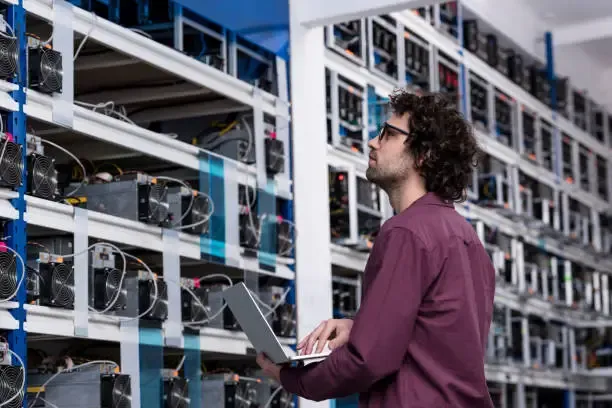
Owning the hardware is only half the battle; operating it is the other. Heat is the enemy of all electronic components. Crypto mining equipment converts electricity into two things: digital currency and heat. If you cannot dissipate that heat effectively, your equipment will throttle (slow down) or permanently fail.
By late 2025, we have seen a significant shift toward advanced cooling solutions. While standard air cooling (fans) remains common for home miners, serious setups often utilize immersion cooling. This involves submerging the mining hardware in a non-conductive dielectric fluid. This method not only eliminates fan noise—a major pain point for home miners—but also extends the lifespan of the chips by maintaining a stable temperature. While immersion setups require a higher initial investment, they are protecting the asset that generates your revenue.
Furthermore, electrical infrastructure cannot be overlooked. A modern ASIC can draw over 3,000 watts continuously. Standard residential wiring is often insufficient for more than one or two units. Before purchasing crypto mining equipment, you must consult with an electrician to ensure your dedicated circuits can handle the amperage without creating a fire hazard.
Avoiding Scams in the Hardware Market
One of the most persistent issues in this industry is the prevalence of fraud. The demand for crypto mining equipment often outstrips supply, creating a breeding ground for fake websites and predatory sellers. A common scam involves selling "futures" or pre-orders for non-existent machines that are never delivered.
To protect your capital, always verify the vendor. Look for companies with a long track record, verified reviews on third-party forums, and transparent warranty policies. Be wary of sellers who only accept cryptocurrency payments without offering a credit card option or purchase protection. Additionally, be skeptical of used hardware sold as "new." Mining equipment degrades over time; buying a machine that has been run at full capacity in a hot warehouse for two years is a risky investment. Always ask for hash logs or proof of operation when buying second-hand.
Strategic Conclusion
Entering the mining space in 2025 is a business decision that requires mathematical rigor. The days of easy money are behind us, replaced by a mature industry that rewards efficiency and planning. Whether you choose the raw power of ASICs for Bitcoin or the versatile agility of GPUs for altcoins, your success depends on selecting crypto mining equipment that balances performance with power consumption. By focusing on the J/TH efficiency metric, ensuring proper cooling infrastructure, and sourcing from reputable suppliers, you can build a mining operation designed for longevity and profitability in the digital asset economy.