
Revenue Assumption Baseline
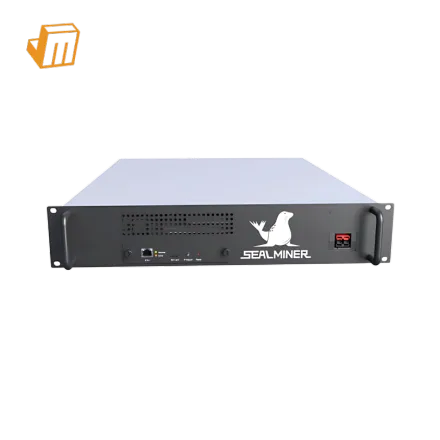
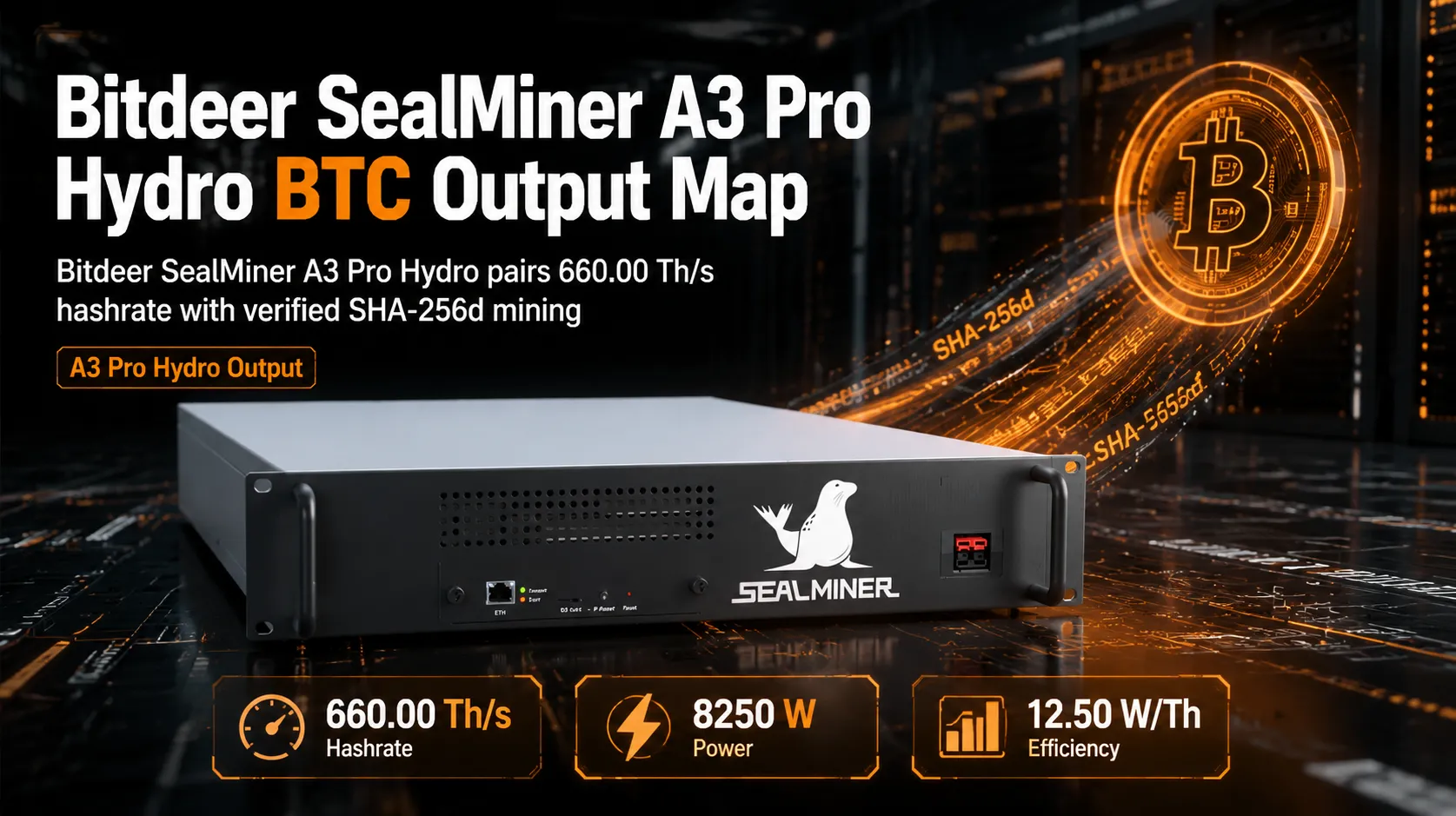
The Bitdeer SealMiner A3 Pro Hydro, with its formidable 660.00 Th/s hashrate dedicated to the SHA-256 algorithm, presents a substantial revenue generation capability within the Bitcoin mining ecosystem. This high output positions the miner competitively, aiming to capture a significant share of block rewards. However, the conversion of this raw hashing power into tangible revenue is intrinsically linked to the fluctuating price of Bitcoin, the ever-increasing network difficulty, and the efficiency with which the miner operates. While the 660.00 Th/s establishes a high ceiling for potential earnings, the dynamic nature of the crypto market dictates that actual daily or monthly revenue figures will vary considerably, making any fixed projection unreliable without real-time market data.
Operational expenses, primarily driven by the 8250 W power draw, are a critical factor in determining net profitability. At an efficiency of 12.50 W/Th, the A3 Pro Hydro is designed to be competitive, but its substantial power requirement means that electricity costs will form the largest component of ongoing expenditure. Therefore, while the hashrate dictates the potential gross revenue, the efficiency and the prevailing electricity rates are paramount in safeguarding profit margins and influencing the eventual payback period. Buyers must model their expected revenue based on their specific electricity tariff and a realistic assessment of Bitcoin's future price and network difficulty trajectory, rather than relying on static or historical averages.
Strategic ROI Matrix
Evaluating the Return on Investment (ROI) for a high-performance hydro-cooled miner like the Bitdeer SealMiner A3 Pro Hydro requires a granular look at its specifications and the broader market dynamics. This matrix highlights key financial variables and their direct impact on the miner's payback potential.
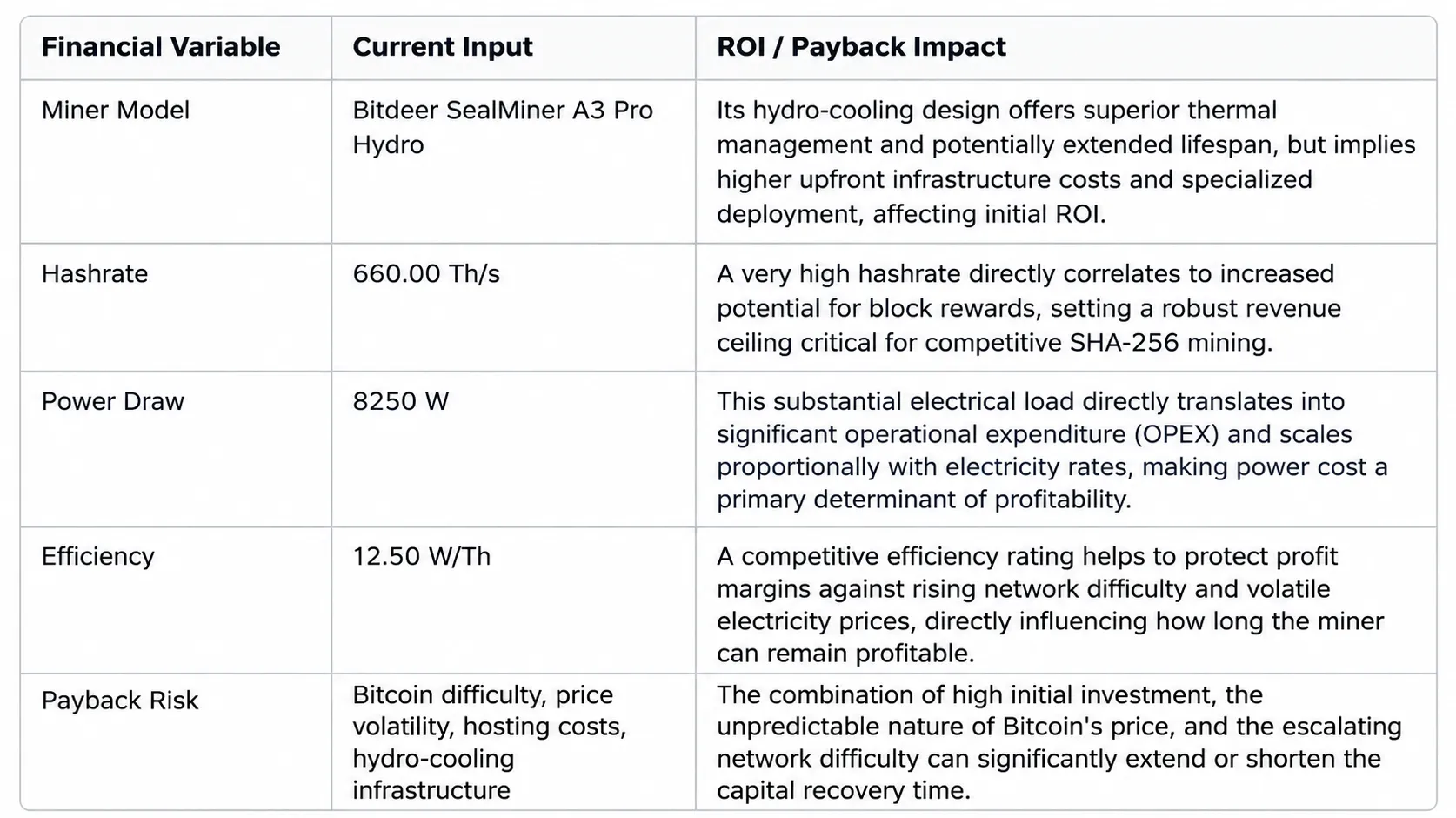
The Bitdeer SealMiner A3 Pro Hydro's specifications reveal a machine built for high output and competitive efficiency, yet its hydro-cooling aspect introduces unique considerations. While hydro-cooling can lead to more stable performance and potentially lower energy consumption per unit of hash over time by maintaining optimal operating temperatures, it also demands a specialized and often more expensive deployment environment. The high power draw of 8250 W means that even marginal shifts in electricity rates can drastically alter the profitability outlook, underscoring the necessity of securing low-cost power for a favorable payback.
Macro-to-Micro Payback Pressure
The macro environment exerts significant pressure on the micro-level economics of Bitcoin mining, directly influencing the payback period for machines like the Bitdeer SealMiner A3 Pro Hydro. Global energy market volatility, driven by geopolitical events and supply chain disruptions, directly translates into fluctuating electricity rates. For a miner consuming 8250 W, even a small increase in electricity cost per kilowatt-hour can dramatically inflate operational expenses, eroding profit margins and extending the time it takes to recoup the initial investment. Conversely, securing long-term, low-cost power contracts in regions with stable energy grids becomes a paramount strategic advantage, fundamentally de-risking the OPEX component of the ROI calculation.
Furthermore, the Bitcoin network's inherent difficulty adjustments and halving cycles cast a long shadow over future profitability. As more powerful hardware comes online and the network difficulty rises, the 660.00 Th/s output of the A3 Pro Hydro, while substantial today, may yield fewer block rewards proportionally in the future. The upcoming halving events will further reduce the block subsidy, forcing miners to rely more heavily on transaction fees and Bitcoin's price appreciation to maintain profitability. This macro-level dynamic necessitates a payback model that accounts for diminishing returns on hashing power over time, emphasizing the urgency of achieving a swift ROI before these network-wide changes fully materialize.
Payback Verdict & Next Steps
The Bitdeer SealMiner A3 Pro Hydro represents a significant capital expenditure, designed for high-performance SHA-256 mining in specialized hydro-cooled environments. Its impressive 660.00 Th/s hashrate and competitive 12.50 W/Th efficiency offer a strong foundation for revenue generation, but the path to payback is critically dependent on two primary factors: securing exceptionally low and stable electricity rates for its 8250 W power draw, and a favorable, sustained Bitcoin price trajectory relative to network difficulty increases. The hydro-cooling system, while enhancing longevity and performance stability, also adds to the complexity and cost of deployment, which must be factored into the overall payback calculation. For operators with access to optimized infrastructure and highly competitive power, the A3 Pro Hydro presents a compelling opportunity, but for others, the high OPEX sensitivity and initial setup investment pose considerable payback risks.
To gain a precise and personalized understanding of the Bitdeer SealMiner A3 Pro Hydro's potential ROI for your specific operational context, we strongly recommend a detailed consultation. Contact JingleMining today for a custom ROI model tailored to your exact electricity rates and deployment scenario, procurement validation, or expert deployment consulting to ensure your investment is optimized for maximum payback.
Frequently Asked Questions (FAQ)
Q: What variables matter most in payback analysis?
A: The most critical variables in payback analysis for an ASIC miner are its hashrate (output), power draw (electricity consumption), efficiency (W/Th), and the prevailing electricity rates. Additionally, the current and projected price of the mined cryptocurrency and the network's mining difficulty are paramount.
Q: How does electricity cost change the ROI outlook?
A: Electricity cost is typically the largest operational expense for ASIC miners. Even small fluctuations in the per-kilowatt-hour rate can significantly impact the net profit margin and extend or shorten the payback period, especially for high-power machines.
Q: What should buyers verify before trusting a payback estimate?
A: Buyers should verify the assumed electricity rates, the current network difficulty and anticipated increases, and realistic projections for the cryptocurrency's price. It is also crucial to confirm the miner's exact power draw and efficiency under real-world operating conditions, not just theoretical maximums.