
Revenue Assumption Baseline
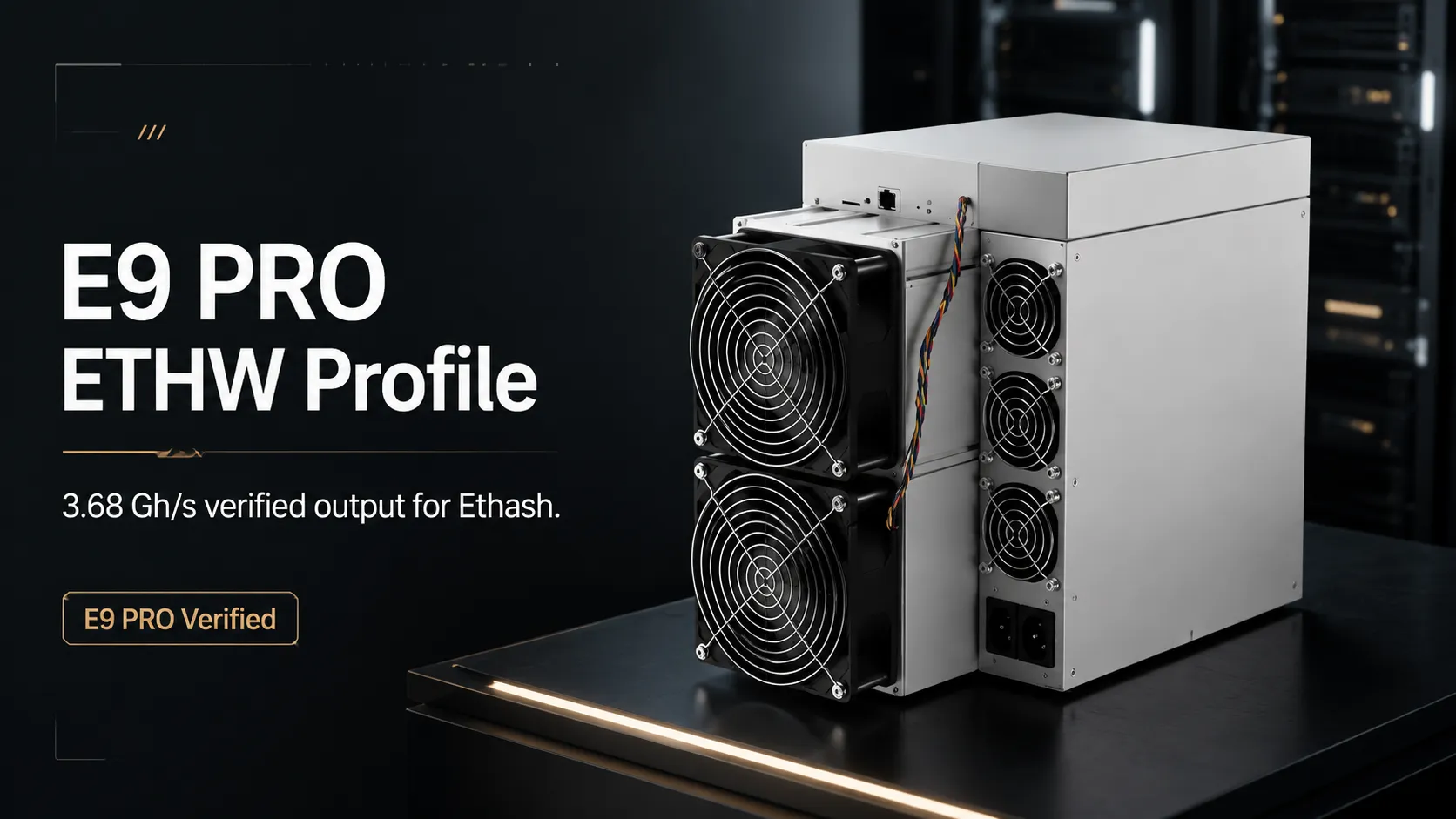
The Bitmain Antminer E9 PRO stands as a formidable machine in the EtHash/Etchash mining landscape, specifically engineered for mining cryptocurrencies like Ethereum Classic (ETC). Its core revenue generation capability is anchored by a robust hashrate of 3.68Gh/s. This impressive processing power directly dictates the volume of ETC that can be mined over a given period, assuming stable network conditions. While the E9 PRO's high hashrate establishes a strong ceiling for potential earnings, actual revenue realized is always a dynamic interplay between this raw computational output, the current market price of ETC, and the ever-fluctuating network difficulty of the EtHash algorithm. A higher hashrate provides a competitive edge in securing block rewards, but market volatility remains a critical external factor.
Beyond raw hashrate, the operational efficiency of the E9 PRO is crucial for sustainable revenue. With a power draw of 2200 W and an efficiency rating of 597.83 W/GH, this miner presents a specific operational expenditure profile. These specifications are fundamental to calculating the cost-per-unit of cryptocurrency mined. In environments with varying electricity rates, this efficiency becomes a primary determinant of net profitability. While the E9 PRO is designed to deliver significant mining power, the sustained viability of its revenue stream is directly tied to managing electricity costs effectively and understanding that net revenue will be the gross mining reward minus these substantial operational overheads.
Strategic ROI Matrix
Evaluating the Bitmain Antminer E9 PRO's investment viability requires a meticulous breakdown of its technical specifications against potential financial impacts. The following matrix outlines how key variables directly influence the return on investment and the anticipated payback period for this dedicated EtHash miner.
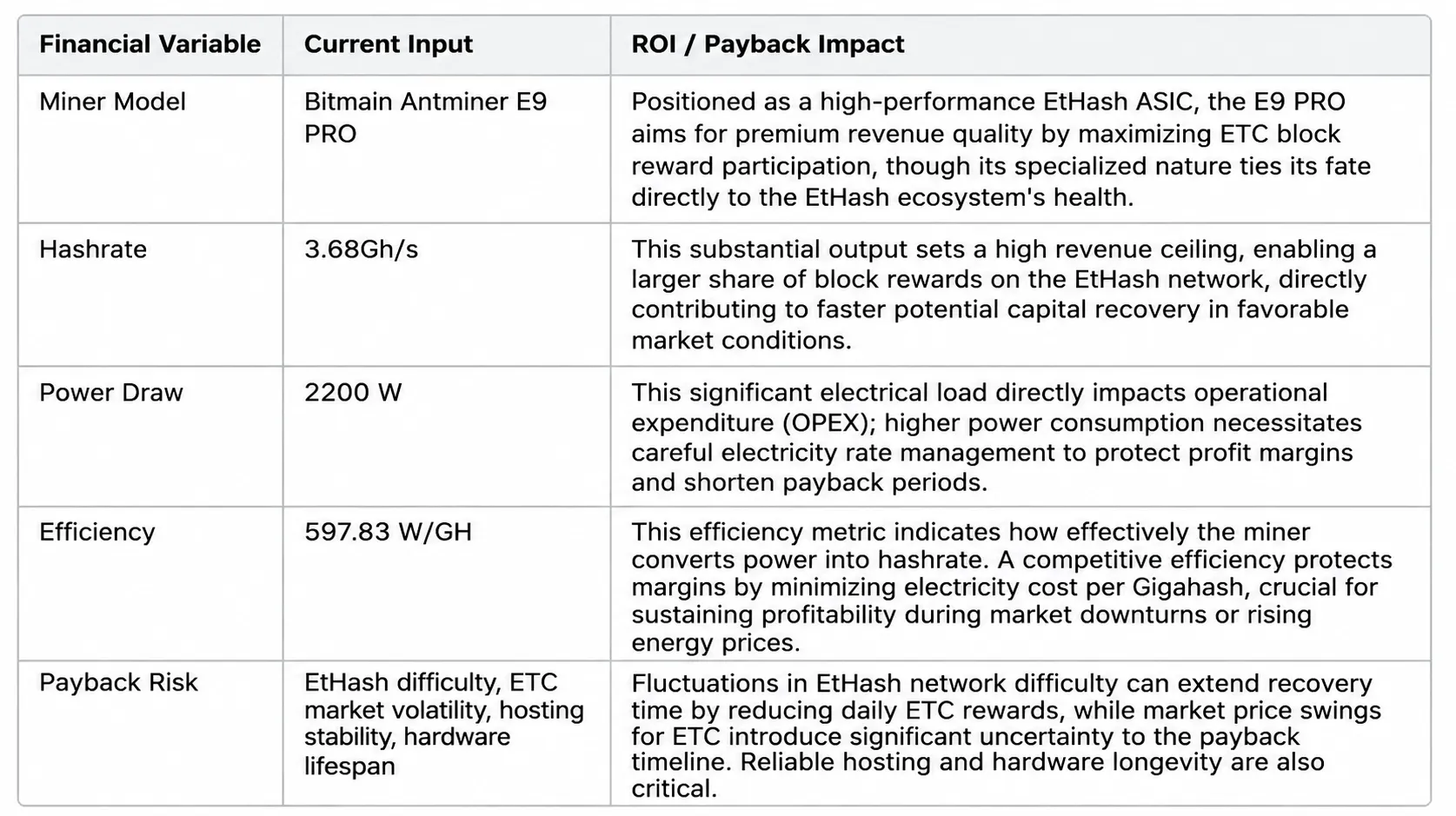
The variables presented in this matrix highlight the integrated nature of mining profitability. The E9 PRO's high hashrate and competitive efficiency are designed to maximize gross revenue and mitigate the impact of its considerable power draw. However, the overarching payback risk, driven by the inherent volatility of the cryptocurrency market and the dynamic nature of EtHash network difficulty, underscores the necessity for thorough due diligence. A higher hashrate can accelerate payback, but only if the cost of power remains manageable and the market price of ETC holds strong, emphasizing the delicate balance between high output and operational cost.
Macro-to-Micro Payback Pressure
Global macroeconomic trends and specific cryptocurrency market dynamics exert direct, tangible pressure on the Bitmain Antminer E9 PRO's payback period. For instance, rising global energy prices, often influenced by geopolitical events or supply chain disruptions, directly translate into increased operational expenditures (OPEX) for the E9 PRO's 2200 W power draw. A surge in electricity rates can quickly erode profitability, extending the time it takes to recover the initial investment, even for an efficient machine. This macro-level energy inflation means that what might have been a profitable venture at 0.05/kWh becomes significantly less attractive, or even loss-making, at 0.10/kWh, pushing the payback horizon further out.
Furthermore, the broader cryptocurrency market sentiment, influenced by factors such as interest rate decisions, regulatory news, or even the performance of major assets like Bitcoin, can profoundly affect the price of Ethereum Classic (ETC). A bearish market trend leading to a sustained drop in ETC's value directly reduces the dollar-denominated revenue generated by the E9 PRO, regardless of its consistent 3.68Gh/s hashrate. This market-driven revenue contraction immediately elongates the payback period, as more time is required to accumulate sufficient ETC value to offset the miner's purchase price and ongoing OPEX. Moreover, increasing EtHash network difficulty, a natural consequence of more miners joining the network or existing miners upgrading, directly reduces the amount of ETC rewarded per Gigahash, placing additional pressure on the E9 PRO's profitability and making payback a moving target.
Payback Verdict & Next Steps
The Bitmain Antminer E9 PRO offers a compelling proposition for EtHash mining with its high hashrate and specialized efficiency, positioning it for strong revenue generation under optimal conditions. However, the financial verdict hinges critically on a miner's ability to secure competitive electricity rates and their tolerance for market volatility inherent in assets like ETC. While its specifications are designed for robust performance, the actual payback period is highly sensitive to energy costs and the fluctuating price of the mined asset, demanding a proactive risk management approach. Prudent investors must model various scenarios for electricity tariffs and ETC price movements to ascertain a realistic and achievable return on investment.
To navigate these complexities and validate your investment strategy, we strongly recommend a personalized assessment. Contact JingleMining today for a custom ROI model tailored to your specific operational costs and market outlook. Our experts can assist with procurement validation, ensuring you acquire the right hardware, and provide deployment consulting to optimize your mining setup for maximum efficiency and profitability.
Frequently Asked Questions (FAQ)
Q: What variables matter most in payback analysis?
A: The most critical variables are the miner's hashrate, its power consumption and efficiency, the current market price of the cryptocurrency being mined, the network's mining difficulty, and your specific electricity costs. These factors collectively determine both gross revenue and operational expenses.
Q: How does electricity cost change the ROI outlook?
A: Electricity cost is typically the largest operational expense for ASIC mining. Higher electricity rates directly increase OPEX, reducing net profitability and significantly extending the payback period, potentially turning a profitable venture into a loss-making one if not carefully managed.
Q: What should buyers verify before trusting a payback estimate?
A: Buyers should verify the assumed electricity rates, the current network difficulty and projected growth, the cryptocurrency's market price and historical volatility, and any associated pool fees or hosting charges. It's crucial to use real-world, current data rather than idealized projections.